


ORANJESTAD, Aruba — A strong Parent Child Connection does not always require an expensive outing, major celebration or carefully planned activity.
According to guidance shared by Tienda di Educacion, children often remember the ordinary moments when their parents or caregivers gave them genuine attention.
Listening carefully shows children that their thoughts, feelings and experiences are important. These small moments can strengthen trust, encourage open communication and help children feel safer, valued and appreciated.

Five Simple Ways to Connect
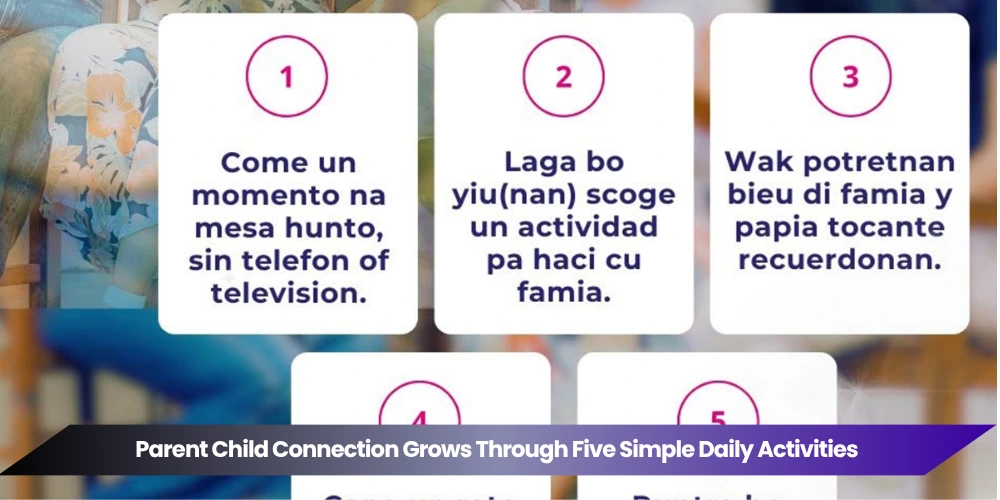
Tienda di Educacion’s educational graphic presents five practical activities families can include in their daily routines.
1. Share a Meal Without Screens
Parents can choose one meal or snack to enjoy together without phones, television or other electronic devices.
Removing digital distractions creates an opportunity for family members to look at one another, discuss their day and listen without interruptions.
The meal does not need to be elaborate. The purpose is to create a calm period when everyone can be present and communicate.
2. Let Your Child Choose an Activity
Allowing children to select a family activity shows that their interests and opinions matter.
The chosen activity could include:
- Playing a board game;
- Drawing or colouring;
- Preparing a simple snack;
- Reading a book;
- Playing outside;
- Listening to music;
- Completing a puzzle.
Parents can participate enthusiastically even when the activity would not normally be their first choice.
Giving children an appropriate level of choice can also help them develop confidence and decision-making skills.
3. Look at Old Family Photographs
Families can look through old photographs and discuss the people, places and memories shown in them.
Parents might explain where a picture was taken, what happened that day or how family members celebrated traditions in the past.
Children can also ask questions and share which photographs they find most interesting.
These conversations can help children understand their family history, strengthen their sense of belonging and create opportunities for parents to share meaningful memories.
4. Take a Walk and Talk Together
A short walk can provide a relaxed environment for conversation.
Parents can walk through the neighbourhood, visit a nearby park or simply spend several minutes outside with their children.
Some children find it easier to discuss their feelings while walking beside a parent instead of sitting through a formal conversation.
The parent can ask about school, friendships, hobbies or something the child noticed during the day.
5. Ask One Meaningful Question
Instead of asking only, “How was your day?” parents can use questions that encourage a more detailed response.
Examples include:
- What was your favourite part of today?
- Did anything make you laugh?
- What was difficult today?
- What are you proud of?
- Did someone do something kind for you?
- What would you like us to do together?
Parents should allow children enough time to answer and listen without immediately correcting, judging or interrupting them.
Full Attention Strengthens Communication
The quality of the interaction matters more than the number of activities completed.
The US Centers for Disease Control and Prevention says active listening—including giving children full attention, making appropriate eye contact and acknowledging their emotions—can strengthen communication and help children feel secure.
Children are also more likely to discuss their hopes, concerns and problems when they believe their parents will listen and support them.
Parents do not always need to solve the situation immediately. Sometimes children first need to know that someone understands what they are experiencing.
Small Conversations Support Development
Responsive, back-and-forth interactions between children and caring adults can also support language, social skills and emotional development.
Harvard University’s Center on the Developing Child describes these exchanges as “serve and return” interactions. A child communicates through words, expressions or actions, and the caregiver responds with interest and attention.
These exchanges can happen during ordinary routines, including meals, playtime, travelling to school or preparing for bed.
The important element is the parent’s willingness to notice the child’s communication and respond.
Quality Time Does Not Need to Be Expensive
Families may sometimes feel pressured to organise large activities, purchase gifts or travel somewhere special to create meaningful memories.
However, connection can develop through ordinary activities that cost little or nothing.
UNICEF advises parents to be present during small daily moments and notes that talking, reading and playing together can provide more meaningful interaction than relying heavily on screens.
Even a short period of undivided attention can become valuable when it is consistent and genuine.
Activities Should Match Each Child
Every child communicates differently.
Some children enjoy long conversations, while others express themselves more easily through drawing, movement, games or shared activities.
Parents should consider the child’s:
- Age;
- Personality;
- Communication abilities;
- Interests;
- Emotional needs;
- Comfort with physical affection.
A successful connection activity for one child may not work in the same way for another.
The objective is not to force conversation but to create a welcoming environment in which the child feels safe enough to participate.
Consistency Is More Important Than Perfection
Parents and caregivers do not need to create perfect family moments every day.
Busy schedules, employment, school responsibilities and household pressures can make extended family time difficult.
A realistic approach is to identify small opportunities that can be repeated consistently.
A device-free meal, a short walk, an old photograph or one thoughtful question can become part of the family’s routine.
The central message from Tienda di Educacion is that a strong Parent Child Connection is created through the quality of the time families share—not through the size, price or number of activities they organise.