

ORANJESTAD, Aruba — The Aruba 100-Ton Cleanup is aiming to collect 100 tonnes of waste in one day as residents, businesses, clubs and community organisations participate in the National Day to Care for Aruba.
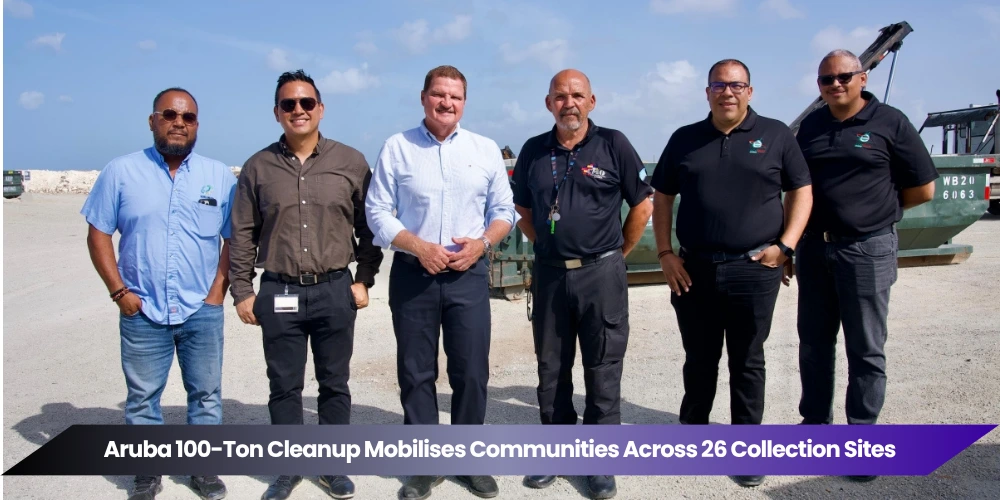
Government representatives and participating organisations presented their final logistical preparations during a press conference at the Parkietenbos waste zone one day before the national campaign.
The cleanup takes place on Saturday, July 25, 2026, under the slogan “For me. For you. For all of us.”

Prime Minister Mike Eman said the initiative is designed to bring the community together around the shared goal of keeping Aruba clean, healthy and attractive.
The Government of Aruba previously confirmed that the campaign’s target is to collect 100 tonnes of waste in a single day.
Twenty-Six Collection Locations Prepared
The final campaign briefing announced that 26 waste-delivery locations would operate across Aruba beginning at 7 a.m.
Residents may bring waste collected from their homes, gardens, streets, neighbourhoods, community centres, sports clubs and recreational areas.
The official campaign platform published collection locations covering San Nicolas, Cura Cabay, Mabon, Brazil, Savaneta, Pos Chiquito, Dakota, Santa Cruz, Paradera, Oranjestad, Tanki Leendert and Noord.
Eman thanked the government departments, companies, volunteers and organisations that provided personnel, equipment and other resources.
He said the Aruba 100-Ton Cleanup represents more than an attempt to remove accumulated waste.
The wider objective is to strengthen unity, neighbourhood cooperation and shared responsibility for the island’s public spaces.
CMO Coordinates Collection Sites
Crisis Management Office Director Rino Hermans said CMO met with the coordinators assigned to the different collection locations.
Volunteers will guide arriving residents, manage traffic and explain where each type of waste must be deposited.
Hermans encouraged residents to separate their waste before leaving home.
Pre-sorting materials can reduce unloading times, prevent congestion and help waste-management teams process larger quantities more efficiently.
Residents are being asked to follow the directions provided by volunteers and site coordinators throughout the operation.
Ecotech Emphasises Waste Separation
Ecotech Sales and Marketing Manager Julio Wever stressed that different types of waste must be kept separate.
Metal, bulky household items, garden waste and other approved materials should be placed in their designated collection areas.
Proper separation helps Ecotech handle, transport and process the materials more efficiently.
Ecotech will receive approved waste at the Parkietenbos waste zone from 7 a.m. until 2 p.m.
Asbestos, hazardous substances and dead animals will not be accepted as part of the national cleanup campaign.
Residents who discover asbestos or unknown chemicals should not attempt to move or transport the material themselves.
DOW Supplies Heavy Equipment
The Department of Public Works, known as DOW, is responsible for installing tents, barriers and other equipment at several collection points.
DOW teams will also assist with transporting and removing collected waste.
Trucks and heavy machinery will be available to move large quantities of material and prevent waste from accumulating at busy sites.
CMO will serve as the central coordination point and direct available equipment toward locations experiencing the greatest demand.
This system is intended to keep collection sites operating efficiently throughout the day.
Serlimar Covers Assigned Districts
Serlimar will concentrate much of its work in areas from Savaneta towards the eastern side of the island.
The organisation will support the placement and movement of containers, transportation of collected material and circulation of waste vehicles within its assigned zones.
Coordination among Serlimar, DOW, CMO, Ecotech and other participating partners is intended to prevent delays and traffic congestion.
The agencies will communicate throughout the operation so trucks and equipment can be redirected whenever a collection location begins reaching capacity.
Residents Asked to Protect Their Health
Residents participating in cleanup activities should wear gloves, closed shoes and suitable protection from the sun.
The campaign’s official health guidance recommends sunscreen with an SPF of at least 35, regular hydration and light clothing that protects the arms and legs.
Participants should avoid collecting waste directly with their hands and should request help when lifting heavy objects.
Safety glasses are recommended when handling glass, branches, dust or materials that could affect the eyes.
Children should participate only under adult supervision and must not handle broken glass, chemicals or other hazardous waste.
Campaign Promotes Long-Term Responsibility
The Aruba 100-Ton Cleanup is intended to encourage changes that continue after the national event has concluded.
Government officials said collecting waste for one day will not permanently solve illegal dumping or poor waste-management habits.
Residents, companies and organisations must continue maintaining neighbourhoods, disposing of materials correctly and protecting cleaned public spaces.
The Department of Nature and the Environment has said that monitoring and enforcement will remain important after the campaign.
Aruba’s environmental authorities, police and Public Prosecutor’s Office are cooperating to address substantiated cases of illegal dumping.
Community Invited to Work Together
The government is inviting residents to participate by cleaning around their homes, streets, schools, sports facilities and community spaces.
People with pickup trucks or other suitable vehicles can also assist neighbours who do not have transportation.
Businesses and organisations can contribute employees, machinery, refreshments, safety equipment or logistical support.
The campaign’s message is that Aruba can overcome community challenges when residents and institutions work together despite their differences.
Through the Aruba 100-Ton Cleanup, organisers hope to collect a significant amount of waste while creating a stronger culture of environmental care and shared responsibility across the island.