

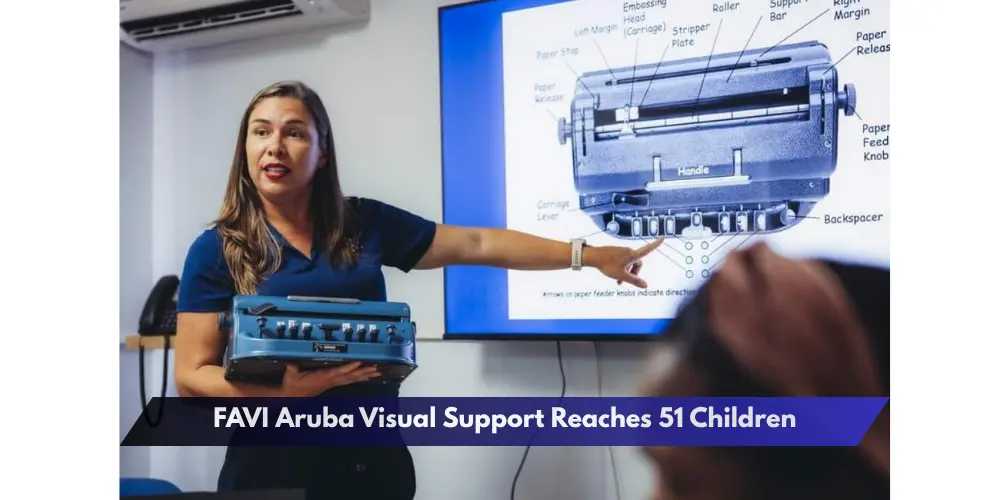
ORANJESTAD, Aruba — FAVI Aruba Visual Support currently reaches 51 children ranging from babies to age 19, as the foundation continues receiving referrals throughout the year for young people who are blind or have limited vision.
Meredith Faarup-Lacle, an ambulant educational support specialist with Fundacion Arubano pa esnan Visualmente Incapacita, said children are referred to FAVI through different health and youth-care services.
According to Faarup-Lacle, referrals arrive throughout the year from organizations including Wit Gele Kruis, or WGK, and Jeugdgezondheidszorg, or JGZ.

Once a visual impairment is identified, FAVI can begin providing guidance based on the child’s age, condition and individual needs.
FAVI Aruba Visual Support Begins Early
The FAVI Aruba Visual Support program can begin when a child is still very young.
Faarup-Lacle explained that visual impairment is not limited to children born with a condition affecting their eyesight.
A child may also lose part or all of their vision because of illness or an accident.
Once the condition is identified by a medical professional and the child is referred, FAVI can begin providing appropriate assistance.
That support can take place at home for babies and very young children or continue in daycare, kindergarten, primary school, secondary education and special education as the child grows.
FAVI Currently Supports 51 Children
Faarup-Lacle said FAVI currently assists 51 children, with the youngest being babies and the oldest currently 19 years old.
The children attend different types of schools throughout Aruba.
These include private schools as well as schools associated with SKOA and DPS.
Rather than requiring visually impaired children to attend one particular institution, FAVI works with them in the educational environment chosen for them.
This allows students, where possible, to continue learning alongside classmates without visual impairments.
Teachers Receive Guidance at School
FAVI’s work does not focus only on the child.
Its ambulant educational support staff also visit schools to provide teachers with information and practical guidance on how to include students with limited vision in classroom activities.
FAVI’s official description of its educational support service confirms that advisers work with visually impaired children in both regular and special education while also guiding their parents, teachers and other caregivers.
The objective is to help the people around the child understand what adjustments may be necessary for effective participation.
Braille and Audio Materials Provided
Students may require learning materials in formats different from those used by classmates.
Depending on the child’s vision, FAVI can help provide books and educational resources in Braille, audio or other adapted formats.
The foundation prepares or coordinates these materials and brings them to the school so students can continue following lessons.
Specialized technology can also form part of this support.
Previous government information about FAVI has highlighted the high cost of Braille equipment connected to computers and the need to adapt schoolbooks so visually impaired children can access the same curriculum as other students.
Goal Is Greater Independence and Inclusion
The broader goal of FAVI Aruba Visual Support is to help children develop the skills needed to function as independently as possible.
Support can extend beyond school and include guidance at home and, later, in the workplace.
FAVI’s wider mission centers on increasing independence, social participation and inclusion for people who are blind or visually impaired.
The foundation currently supports hundreds of clients of different ages across Aruba, while specialized educational staff concentrate on helping children and young people participate in school and daily life.
For the 51 young clients currently receiving assistance, FAVI’s approach is designed to provide support where they already live and learn rather than separating them from their peers.
Through early referrals, adapted materials, teacher guidance and continued assistance, the foundation aims to give visually impaired children opportunities to grow, study and participate alongside other children throughout Aruba.