


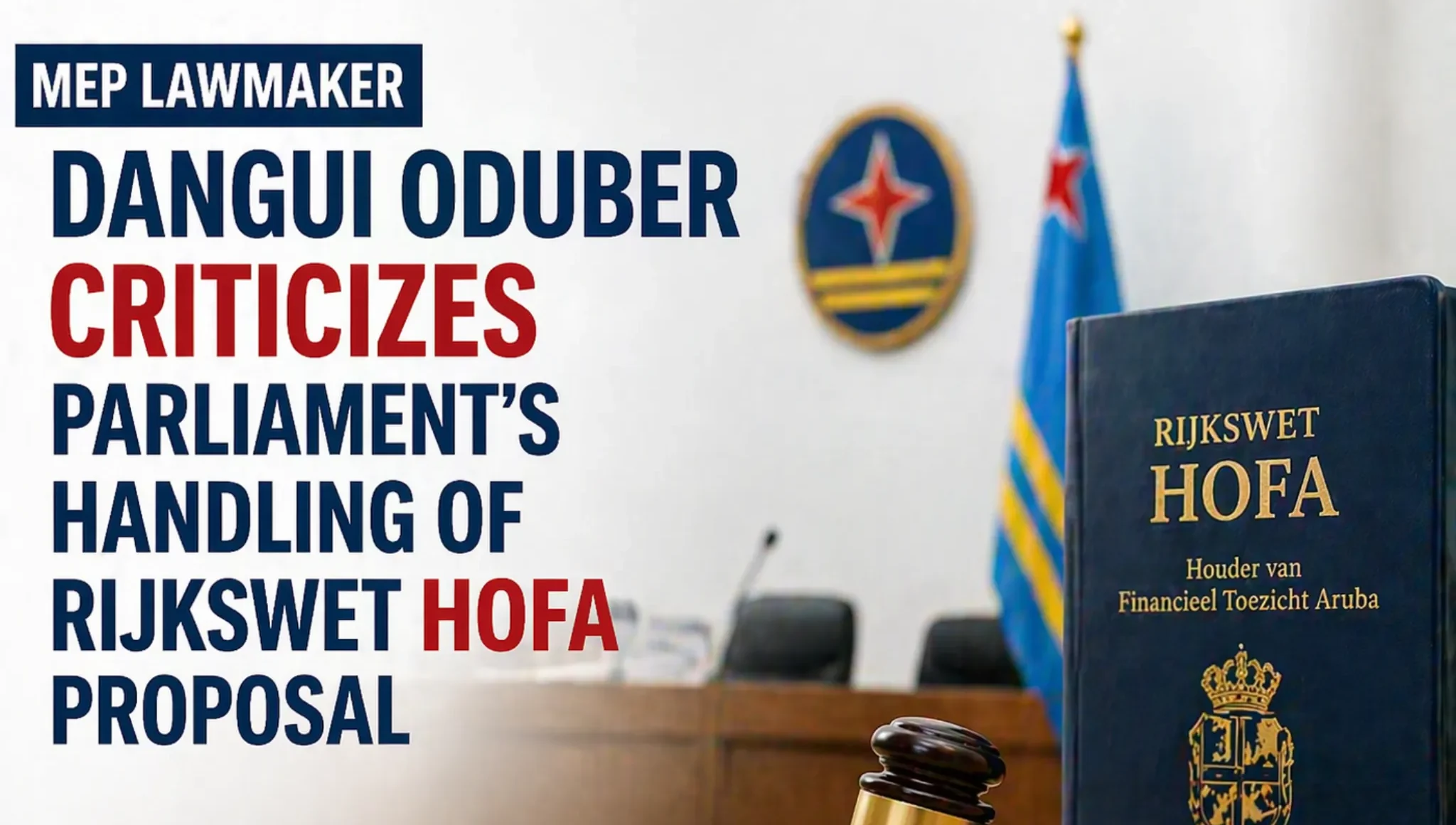
MEP Lawmaker Dangui Oduber Criticizes Parliament’s Handling of Rijkswet HOFA Proposal
ORANJESTAD (AAN): Member of Parliament Dangui Oduber (MEP) has launched a sharp critique against the AVP-Futuro coalition government, accusing it of showing no respect for the people of Aruba after the draft Rijkswet HOFA (Kingdom Law on Financial Supervision of Aruba) was sent to the Netherlands before Parliament had an opportunity to review it.
Oduber stated that sending the draft legislation to the Netherlands before the Parliament of Aruba could even examine it represents a serious affront to the island’s highest democratic institution. He characterized the move as a “bypass” of Aruba’s democracy, arguing that no government should circumvent Parliament on a matter this fundamental.
Parliament Receives Document After Netherlands Already Approved It
According to Oduber, Parliament only received the Rijkswet HOFA document this week for review — after the Dutch Council of Ministers had already approved the proposal. He described the timing as “late” and a total lack of respect, using the expression “mosterd na de maaltijd” (mustard after the meal) to illustrate that Parliament can no longer introduce any changes to the legislation.

“Parliament of Aruba cannot bring ANY changes to this Rijkswet HOFA, and that is something we will not accept,” Oduber emphasized. He argued that the law strips Parliament of its right to approve, reject, or amend the legislation, effectively undermining Aruba’s autonomous governance.
Widespread Opposition to the Rijkswet HOFA
The MEP parliamentarian highlighted the broad opposition to the proposed law across Aruban society. He noted that 10 members of Parliament are openly against the measure, all trade unions on the island oppose it, and more than 10,000 citizens have signed petitions rejecting the Rijkswet HOFA.
Oduber also questioned the position of politicians such as Gerlien Croes and Geoffrey Wever, who he said celebrate living in a free country while simultaneously supporting what he described as selling out Aruba’s financial autonomy. He pointed out that within two years, Aruba’s national debt is projected to fall below 50%, making the imposition of stricter financial oversight difficult to justify.
Aruba Already Complies With Existing Financial Oversight
Oduber noted that Aruba already operates under financial supervision through the Landsverordening Aruba financieel toezicht (LAft), which is anchored in Aruban law. The island is currently complying with all financial standards and paying its debts to the Netherlands, he stated. Given this compliance, Oduber argued there is no valid motive or justification for accepting the Rijkswet HOFA.
“It is sad that this government, together with its parliamentarians, wants to sell out our country in this manner. The freedom of a country is sacred and cannot be negotiated,” Oduber concluded.
Aruba has been an autonomous country within the Kingdom of the Netherlands since 1986, and Oduber stressed that this status has allowed the island to prosper and make its own decisions. The central question, he said, remains: why should Aruba accept the Rijkswet HOFA?