


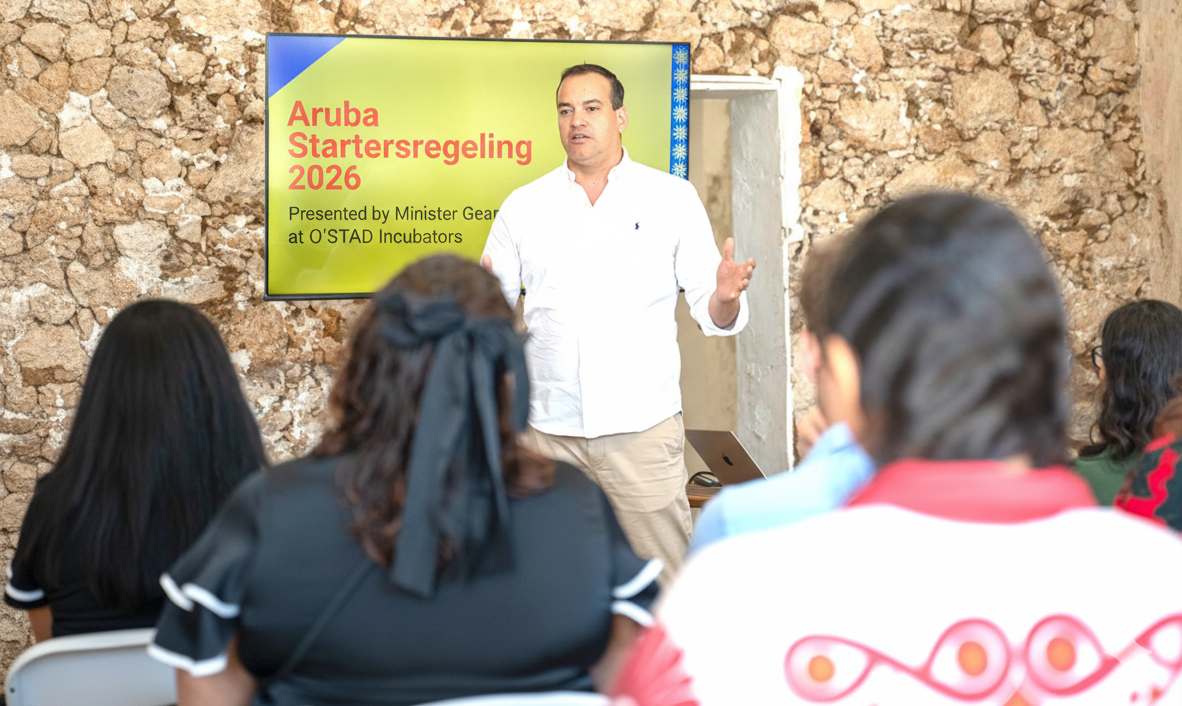
As part of the government’s vision for a more resilient, diversified, and sustainable economy, Minister of Finance, Economic Affairs and Primary Sector Geoffrey Wever presented the Aruba Startersregeling 2026 to O’STAD Incubators and members of Impact Hub Aruba. The initiative forms a key pillar of Aruba’s broader economic strategy to support entrepreneurship, innovation, and the revitalization of downtown Oranjestad.
During an information session organized by Impact Hub Aruba, Minister Wever explained how the Aruba Startersregeling 2026 removes fiscal barriers for new businesses and encourages investment in promising economic sectors. The event was open to O’STAD Incubator participants and all Impact Hub members, focusing on opportunities for establishing businesses in Oranjestad’s city center through the “New Oranjestad” development platform.
Minister Wever detailed two of the newly introduced fiscal incentives: the Aruba Startersregeling 2026 and the preferential investment policy aimed at revitalizing Oranjestad. He emphasized that the Startersregeling is not a standalone measure, but part of a comprehensive economic framework designed to strengthen local businesses, create quality employment, and improve economic resilience. According to the minister, a strong economy begins with healthy local enterprises that can grow sustainably while adding real value to Aruba and its citizens.

The Aruba Startersregeling 2026 applies to businesses established in designated “promising sectors” as defined by the Department of Economic Affairs, Commerce and Industry. These sectors include cultural and medical tourism, the knowledge economy, logistics, agricultural economy, circular economy, and creative industries. By targeting these areas, the government aims to diversify the economy and reduce dependence on traditional sectors.
Companies established from January 1, 2026 onward in these sectors will benefit from tax relief during their first five years of operation. Incentives include annual profit exemptions of up to Afl. 50,000, increased investment deductions, and partial deductions on commercial loans. In return, participating businesses must reinvest at least 15 percent of their gross revenue annually, maintain minimum employment levels, and demonstrate genuine economic presence in Aruba.
The connection between entrepreneurship and urban revitalization was further highlighted through the O’STAD Incubator program. Nine startups are currently preparing for Demo Day, where they will present their businesses to a panel of jurors and local investors. These startups completed an intensive twelve-week program with guidance from Impact Hub Aruba, the University of Aruba, the Chamber of Commerce, and industry professionals.
Minister Wever concluded that initiatives such as the O’STAD Incubator and the Aruba Startersregeling 2026 complement each other by translating economic policy into tangible opportunities for entrepreneurs, particularly in downtown Oranjestad. The ultimate goal is not only to create new businesses, but also to revitalize the urban center, stimulate property investment, and build a dynamic, diversified, and resilient Aruban economy.









Discussion about this post