


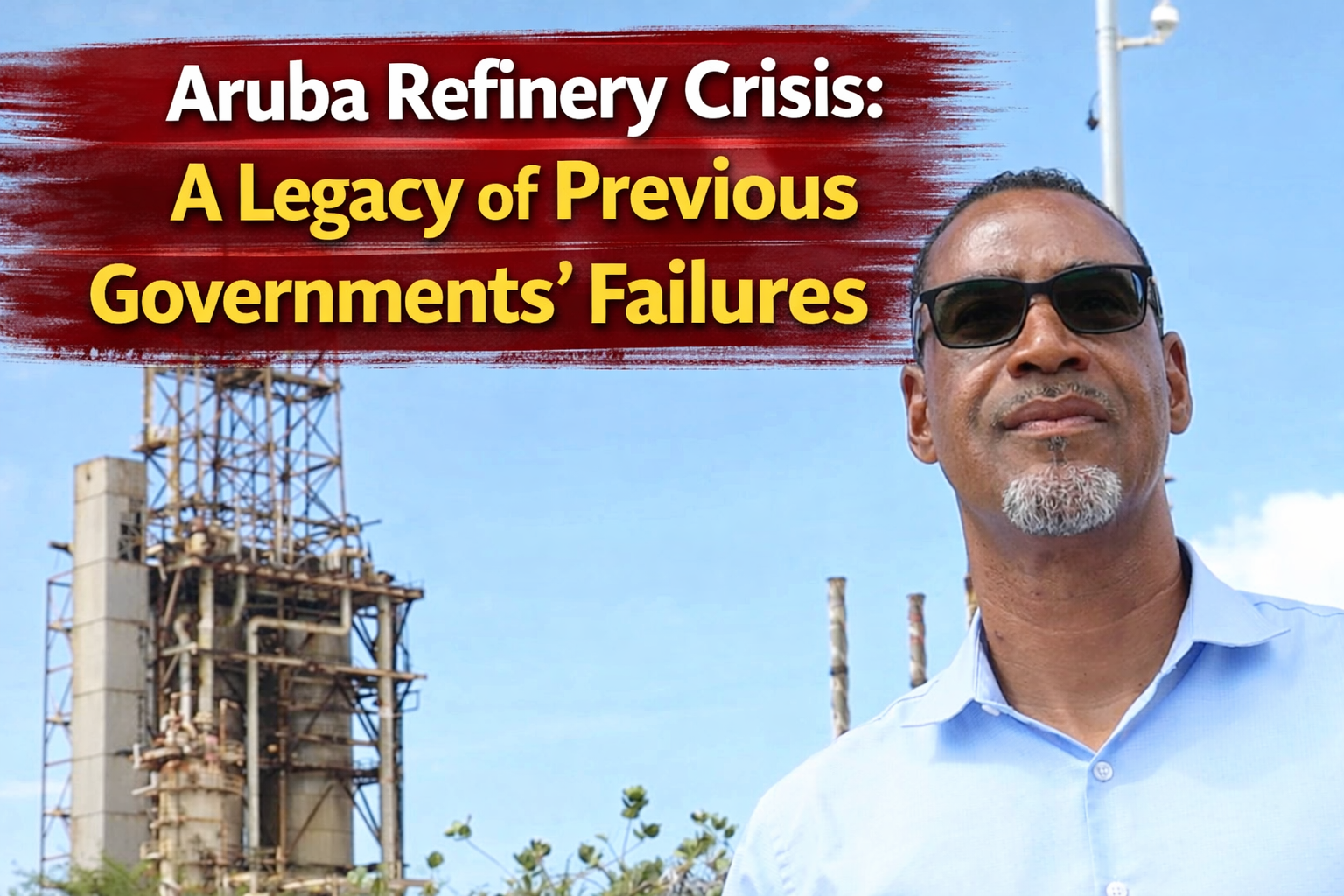
Aruba refinery crisis – Parliamentarian Clifford Heyliger has raised alarm over the deplorable state of Aruba’s refinery, emphasizing that the situation didn’t develop overnight and that the responsibility lies squarely with the last two MEP-led governments.
According to Heyliger, the current deterioration of the refinery is a result of not only the failure to secure the last operator’s cleanup clause but also the lack of action from the government to maintain or repurpose the facilities. He points out that the topic has remained nothing more than empty promises.
As is well-known, the refinery has not been operational since 2012. Despite negotiations with Citgo between 2017 and 2024, there was no serious structural maintenance undertaken at the facility. As a result, the infrastructure has severely deteriorated, with smokestacks and other industrial structures now in a hazardous state.

Heyliger stresses that political decisions made during this period directly contributed to the current situation. Under the lease agreement in effect at the time, Citgo had an obligation to dismantle the refinery under specific conditions, with a maximum responsibility of $150 million. However, the government decided to take the refinery back without enforcing the dismantling clause.
“This decision has placed our country in an extremely vulnerable financial and environmental position,” Heyliger stated. He reminded the public that for several years, there was talk of investors waiting to invest in the refinery, but no real investments ever materialized.
Meanwhile, the government maintained a “wait and see” attitude, without any concrete plan for maintenance, repurposing, or responsible dismantling. The Parliament has now been informed that the government intends to proceed with two goals: a planning process for eventual dismantling, which could take one to two years, and an evaluation of opportunities within the oil industry, such as transshipment terminals and fuel storage.
“We cannot allow the same government that created this problem to wash their hands of it like Pontius Pilate, blaming others,” Heyliger declared. “The reality is that it was the Wever-Croes I and II Cabinets that waived the last operator’s cleanup clause, and they themselves didn’t take any steps to maintain or implement a serious plan for repurposing the refinery.”
The parliamentarian reiterated his call for full transparency in the ongoing process, including the installation of an independent expert commission to assess the structural state, legal responsibilities, and realistic options for the future.
“The people of Aruba deserve the truth. The ruin we are witnessing today is not a result of external circumstances but of specific political decisions. Accountability must be taken, and solutions must be based on facts, not narratives,” Heyliger concluded.
















Discussion about this post