


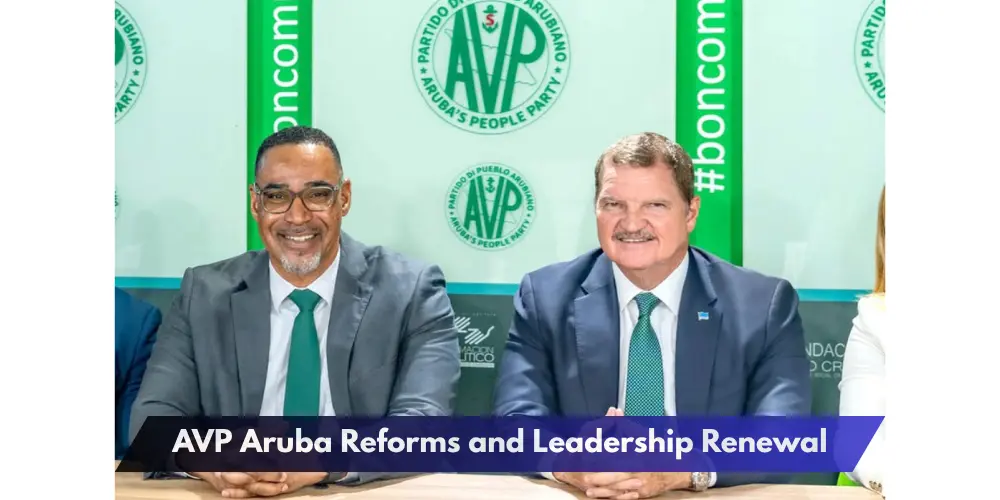
ORANJESTAD, Aruba — AVP Aruba Reforms and the party’s historical role in major political, social and economic changes were highlighted by Prime Minister and AVP leader Mike Eman as he explained why the party’s October 4 congress represents an important moment of leadership renewal.
Speaking during a press conference at the AVP party headquarters, Eman said the upcoming congress should be viewed as more than a change from one party leader to another.
He described it as an opportunity for AVP to transfer responsibility to a new generation while maintaining the principles and values that have shaped the party.

Eman said AVP has repeatedly sought to play a leading role during important periods in Aruba’s development.
AVP Aruba Reforms Highlighted by Eman
According to Eman, AVP Aruba Reforms have been connected with major stages in the island’s political and social development, including the movement toward greater autonomy, Status Aparte and subsequent efforts to modernize Aruba.
These statements reflect Eman and AVP’s assessment of the party’s historical contribution.
Eman said generations of AVP leaders accepted responsibility when Aruba faced new political, economic or social challenges.
He also emphasized the party’s Christian-social philosophy, which he said is based on concepts including solidarity, human dignity, social justice, responsible stewardship and service to the common good.
According to Eman, those principles should remain part of the party even as its leadership changes.
Eman Calls for New Generation of Leadership
Eman said technological and social changes are creating new challenges for Aruba and argued that political organizations must also make room for a generation prepared to respond to them.
He described the coming period as an “era of transition,” in which leadership, governance responsibilities and organizational roles are increasingly passed to a younger generation.
For Eman, effective leadership includes knowing when to create room for others.
He said transferring responsibility should mean more than giving younger politicians an opportunity. It should also involve giving them the trust, authority and space necessary to lead.
Mike Eman Reflects on Political Career
The AVP leader also reflected on his own political career and the support he has received from voters.
Eman previously served as Prime Minister from 2009 to 2017 and returned to the position following the formation of the current AVP-Futuro government.
During the press conference, AVP highlighted policies and reforms implemented during earlier Eman administrations, including public infrastructure investment, pension and healthcare measures and expanded social support.
These achievements were presented by the party as part of the broader history behind AVP Aruba Reforms.
Eman argued that leadership should be measured not only by what a leader accomplishes while in office, but also by the ability to prepare an organization for the future.
AVP Officials Discuss Leadership Transition
AVP board vice president Clifford Heyliger said the upcoming transition carries strong emotions because Eman has represented the party for many years.
However, Heyliger said a strong organization must also be able to renew itself and prepare for the future.
Minister Wendrick Cicilia, who is viewed within AVP as a prominent representative of the party’s younger generation, also discussed the significance of working alongside Eman.
Cicilia said the experience helped shape his understanding of responsibility toward Aruba and the party.
He acknowledged that succeeding an established leader involves significant responsibility and said continuity should include maintaining AVP’s core principles while responding to new challenges.
October 4 Congress to Mark New Chapter
AVP’s congress is scheduled for October 4, 2026, and Eman said it should serve as both a reflection on the party’s history and an opportunity to begin a new phase.
The event is expected to focus heavily on continuity, renewal and the transfer of responsibility to a new generation.
Eman said previous generations accepted responsibility during critical periods for Aruba and that AVP’s responsibility today is to ensure the organization remains relevant and capable of serving future generations.
Through the discussion of AVP Aruba Reforms, Eman framed the leadership transition as an effort to connect the party’s historical experience with its future direction.
His central message was that individual leaders and generations will change, while the party’s stated commitment to Aruba is intended to continue.