

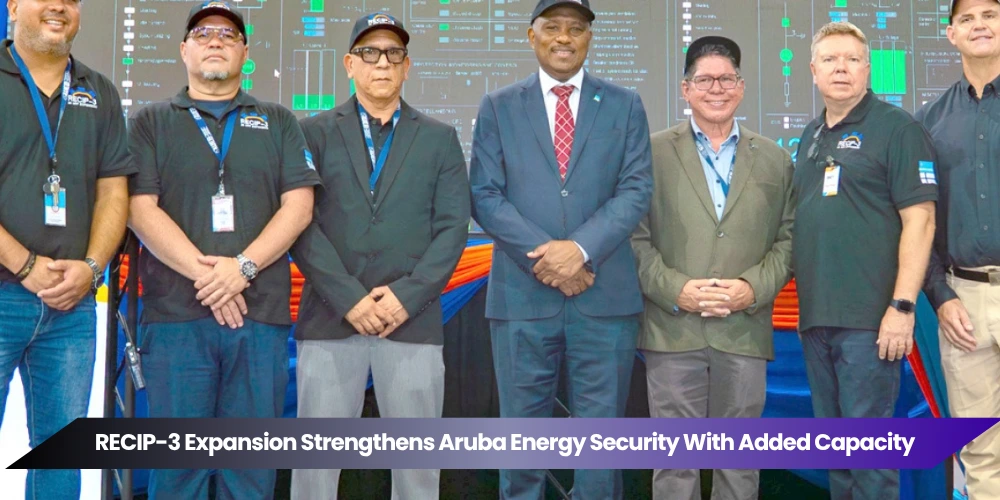
ORANJESTAD, Aruba — The RECIP-3 Expansion at WEB Aruba N.V. has officially entered operation, adding 36 megawatts of installed generation capacity and strengthening the island’s ability to meet growing electricity demand.
Energy Minister Arthur Dowers attended the official project handover on Wednesday morning alongside WEB Aruba management and representatives of Wärtsilä Finland Oy.
During the ceremony, Dowers joined officials in activating the two new RECIP engines, formally placing them into operation.

According to the government announcement, the expansion represents an investment of approximately Afl. 115 million.
RECIP Capacity Rises From 194 to 230 MW
The two additional engines increase WEB Aruba’s Wärtsilä-powered RECIP capacity from 194 MW to 230 MW.
Wärtsilä previously confirmed that the project consists of two 50DF dual-fuel generating units providing a combined additional capacity of 36 MW.
The company said the expansion was necessary because electricity demand in Aruba has increased alongside higher temperatures, tourism growth, new resort construction and residential development.
WEB CEO Alfredo Koolman previously described the project as urgently needed to ensure the utility could continue meeting the island’s growing electricity requirements.
Dowers Calls Project Important for Energy Security
Dowers described completion of the project as an important step toward strengthening the security and reliability of Aruba’s electricity supply.
He said economic activity, tourism, increased consumption and periods of intense heat continue placing additional pressure on electricity production.
The minister argued that Aruba must plan additional capacity before demand grows beyond what the system can reliably provide.
The expansion gives WEB additional firm generation that can be called upon when electricity consumption rises or when other generating resources are unavailable.
Complex Project Completed Ahead of Schedule
Dowers also recognised the technical and logistical work involved in completing the expansion.
Large equipment had to be transported to Aruba, installed at WEB’s Balashi facilities and integrated into the existing power system.
The work required coordination among engineers, contractors, WEB personnel and Wärtsilä specialists while existing generation facilities remained operational.
According to the August 20 announcement, the project was completed approximately one week ahead of its latest planned completion date.
Wärtsilä had originally said the extension was expected to be commissioned and fully operational around the middle of 2026.
Two Dual-Fuel Engines Added to System
The project uses Wärtsilä 50DF dual-fuel technology.
These engines can operate on liquid or gaseous fuels and are designed to provide flexible generation that can respond comparatively quickly to changes in electricity demand.
Wärtsilä says this flexibility is particularly valuable when a grid incorporates more renewable energy because wind and solar output naturally varies according to weather conditions.
Conventional generation can therefore provide balancing capacity when renewable production suddenly increases or decreases.
Expansion Builds on Long Partnership
WEB Aruba and Wärtsilä have worked together on power-generation projects for more than two decades.
Wärtsilä said the RECIP-3 extension represents its fifth engineering, procurement and construction project for WEB Aruba.
Before the latest expansion, Wärtsilä operated four engine-house installations providing 194 MW of generating capacity to Aruba.
Dowers thanked Wärtsilä for its continued cooperation and also recognised WEB management, employees, engineers and other professionals involved in completing the latest project.
Growing Demand Requires More Capacity
Aruba has experienced periods of rapidly increasing electricity demand in recent years.
WEB previously introduced a temporary 20 MW mobile generating plant in 2024 as a short-term response while permanent capacity projects were prepared.
At the time the RECIP-3 project was announced, WEB said the additional 36 MW was intended to provide a medium-term solution to increasing electricity consumption.
The permanent expansion provides additional capacity within WEB’s own generating infrastructure rather than depending exclusively on temporary equipment.
Firm Generation Supports Renewable Energy
Although RECIP-3 adds conventional generating capacity, WEB and Wärtsilä have also presented the project as supporting Aruba’s transition toward more renewable electricity.
Wind and solar production fluctuate throughout the day. A power system therefore requires enough flexible generation or energy storage to maintain balance when renewable output changes unexpectedly.
Wärtsilä says its fast-starting engines can provide that balancing role and make it possible for WEB to integrate larger quantities of wind and solar generation while maintaining grid stability.
This does not mean the new RECIP engines themselves are renewable-energy installations. Their role is to provide dependable and flexible capacity while Aruba develops additional renewable generation and storage.
Battery Storage Remains Part of Energy Plans
WEB has also been examining battery-energy storage as another tool for modernising Aruba’s electricity system.
Battery systems can store electricity when production exceeds immediate demand and return power to the grid when needed.
WEB previously said battery storage, additional renewable generation and RECIP capacity would form part of the island’s strategy for meeting future demand while maintaining reliability.
The latest announcement refers to continued preparations involving solar, wind and storage projects but does not provide new capacities, budgets or completion dates for those initiatives.
Reliability Cannot Be Taken for Granted
Dowers said dependable electricity supply requires continuous planning and investment.
He noted that countries with much larger systems and greater resources can still experience electricity shortages when generating capacity does not keep pace with demand.
For an island system such as Aruba, maintaining sufficient reserve capacity is particularly important because electricity cannot simply be imported from a neighbouring national grid when local production falls short.
WEB must therefore balance expected demand, maintenance requirements, reserve generation and the increasing contribution from renewable resources.
Foundation for Aruba’s Next Energy Phase
The RECIP-3 Expansion provides WEB with 36 MW of additional installed generating capacity at a time when Aruba is preparing for continued economic activity and changes in its energy mix.
Dowers said government’s responsibility is to provide direction and oversight while WEB’s technical professionals remain responsible for operating and developing the production system.
With the two new engines officially commissioned, WEB now has greater RECIP capacity available to support electricity reliability while future wind, solar and energy-storage initiatives are developed.
The minister congratulated WEB Aruba, Wärtsilä and everyone involved in completing the project, describing the expansion as an important investment in both Aruba’s immediate energy security and its longer-term transition toward a more sustainable electricity system.