

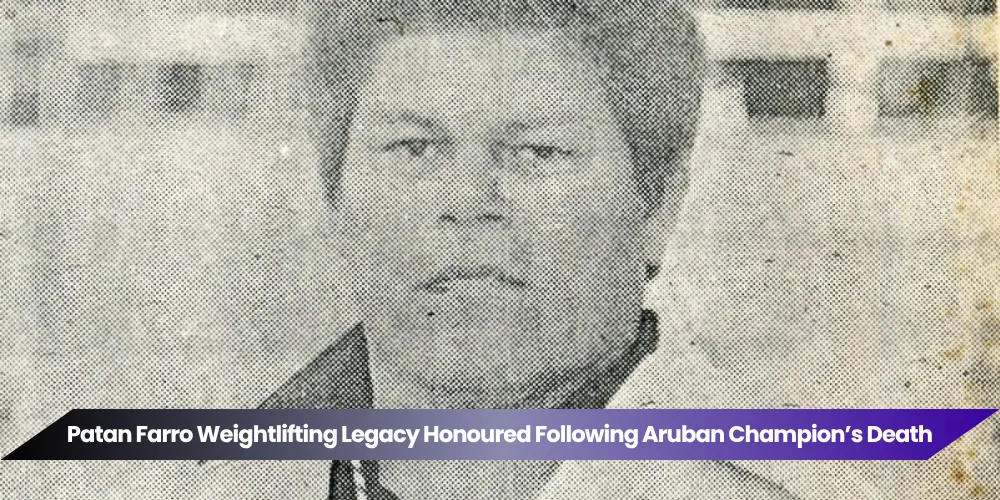
ORANJESTAD, Aruba — The Patan Farro Weightlifting Legacy is being remembered following the death of Higinio Alejandro “Patan” Farro, a pioneering athlete once widely known as the strongest man in Aruba.
The Aruba Amateur Weightlifting Association paid tribute to Farro as an exceptional competitor, role model and respected member of the island’s sporting community.
Farro died on July 30, 2026, at the age of 84.

Competitive Career Began in 1964
Farro entered his first weightlifting competition in Aruba in 1964 and finished in second place.
The following year brought difficulties for the sport. Many foreign athletes who worked at the Lago refinery reportedly left Aruba following layoffs, reducing the number of active weightlifters on the island.
Farro nevertheless continued training and developing his abilities during a period when the sport had limited facilities and support.
Training Conditions Were Extremely Limited
Farro trained in a small room beneath the stands of what was then Wilhelmina Stadion, now known as Stadion Guillermo Prospero Trinidad.
According to the weightlifting association, the room had only one door, a small window and inadequate ventilation. Farro and seven other athletes shared a single lifting platform.
He trained without the guidance of a professional coach and was never given an opportunity to attend an international training camp.
International competition also required personal sacrifice. The association said Farro used his own vacation days when travelling abroad because he did not receive additional leave from his employment.
Farro Paid His Own Way to Panama
In 1970, Farro was selected to represent the Netherlands Antilles at the Central American and Caribbean Games in Panama.
The Aruba Amateur Weightlifting Association said the Netherlands Antilles Olympic Committee declined to finance his trip. Farro reportedly purchased his own airline ticket and proceeded to compete, finishing fourth in his category.
His decision demonstrated the determination that would define much of his athletic career.
The association also credits Farro with a fifth-place finish at the 1971 Pan American Games in Cali, Colombia, and another fourth-place result at the 1974 Central American and Caribbean Games in the Dominican Republic.
Bronze Medal Marked Major International Achievement
Farro’s most significant reported international result came during the 1978 Central American and Caribbean Games in Medellín, Colombia.
He earned a bronze medal while representing the Netherlands Antilles, according to the weightlifting association.
Historical competition records show that the Netherlands Antilles finished the 1978 Games with four medals overall, including two bronze medals. However, the publicly accessible result reviewed did not identify all individual medallists by name.
Champion for More Than a Decade
Farro was reportedly Aruba’s weightlifting champion for 14 consecutive years and Netherlands Antilles champion for nine consecutive years.
The association said he repeatedly improved his own records and achieved notable strength figures during the 1970s.
It credited him with:
- A 600-pound squat;
- A 700-pound deadlift;
- A 400-pound bench press;
- A 275-pound snatch;
- A 352-pound clean and jerk.
The squat, deadlift and bench-press figures reflect strength-training movements rather than the two lifts used in modern Olympic weightlifting competition.
Farro’s 1976 Aruban records in the snatch and clean and jerk reportedly remained unbroken for approximately 40 years before both marks and his combined total were surpassed in 2016.
Recognition Arrived Later in Life
Despite his national titles and international appearances, the association said Farro received limited recognition during his active athletic career.
His accomplishments were formally honoured years after his retirement.
Farro received a royal decoration, was inducted into Aruba’s Hall of Fame and received the Premio Santa Anna for his contributions to culture and weightlifting.
Archivo Nacional Aruba’s collection also identifies him as a nominee for the Arubaanse Sport Unie’s athlete-of-the-year award in 1974.
Legacy Extended Beyond Competition
Farro’s influence extended beyond records and medals.
He demonstrated that an Aruban athlete could compete regionally despite limited facilities, a lack of professional coaching and financial obstacles.
His willingness to continue training and personally finance international travel made him an example of perseverance for later generations of athletes.
Farro was also known for preserving Aruba’s cultural heritage, particularly through his dedication to restoring, maintaining and promoting the traditional Cah’i Orgel.
Association Extends Condolences
The Aruba Amateur Weightlifting Association described Farro as both an outstanding weightlifter and a remarkable human being.
The organisation extended its condolences to his wife, children, grandchildren and other relatives.
The Patan Farro Weightlifting Legacy remains connected to an important period in Aruba’s sporting history—one in which an athlete succeeded through personal discipline, sacrifice and determination despite limited institutional support.
His championship record, international performances and decades-long influence ensure that Farro will continue to be remembered as one of Aruba’s most significant weightlifting figures.