


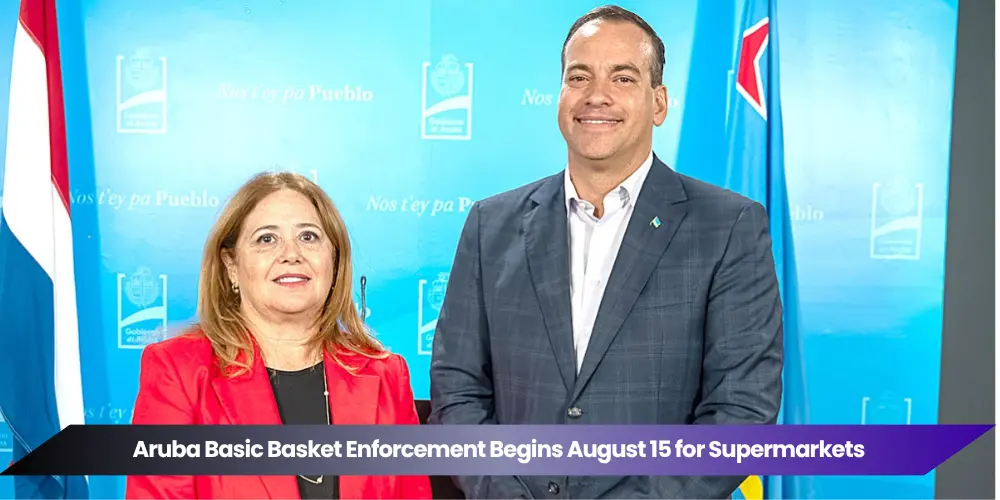
ORANJESTAD, Aruba — Aruba Basic Basket Enforcement will officially begin on August 15, 2026, giving authorities greater power to act against supermarkets and minimarkets that sell regulated essential products above their established maximum prices.
Minister of Finance, Economic Affairs and Primary Sector Geoffrey Wever said the measure is intended to strengthen consumer protection and help ensure that Aruban families pay legally permitted prices for essential supermarket products.
DEACI Monitors Around 1,300 Products
The Department of Economic Affairs, Commerce and Industry, known as DEACI, conducts daily inspections covering approximately 1,300 products included in Aruba’s basic basket.

Inspectors visit supermarkets and minimarkets to determine whether regulated products are being sold within the maximum prices established by the government.
They may also verify whether products display their prices clearly and investigate complaints submitted by consumers.
The official maximum-price list is updated approximately every two weeks to reflect authorised pricing changes. Residents can consult the published lists or use DEACI’s Control di prijs application to review regulated prices.
Previous System Relied Mainly on Warnings
Before the legal change, DEACI inspectors could identify a product being sold above its maximum price and instruct the business to correct the violation.
However, the department’s ability to impose direct administrative consequences was limited.
This meant that inspectors could issue warnings, but businesses that continued violating the regulated prices could not always be addressed through an effective administrative enforcement process.
The new framework is intended to close that enforcement gap.
Businesses Will Receive Time to Correct Violations
The start of Aruba Basic Basket Enforcement does not mean that every pricing error will automatically result in an immediate fine.
When inspectors identify a violation, the merchant may first receive instructions and a period in which to correct the price.
A business that fails to comply after receiving notice or after the correction period has expired may then face an administrative fine or another legally available enforcement measure.
This approach gives businesses an opportunity to address genuine mistakes while allowing the government to act when violations continue.
Measure Seeks Compliance, Not Punishment
Wever said the primary objective is not to punish supermarkets.
The government instead wants all businesses selling regulated products to operate under the same rules.
Most supermarkets reportedly comply with the maximum prices, but officials said some businesses continue charging more than the permitted amounts for certain products.
Effective enforcement is intended to prevent non-compliant businesses from gaining an unfair advantage over stores that follow the regulations.
It should also give consumers greater confidence that the price controls established for essential goods are being respected.
What the Basic Basket Means for Consumers
Aruba’s basic basket contains essential products for which the government establishes maximum retail prices.
The system is intended to protect consumers from excessive increases affecting important household goods.
A maximum price is the highest amount a merchant may legally charge for the specific regulated product, brand, size or package listed by DEACI.
It does not necessarily mean every supermarket must sell the product at exactly that amount. Stores may charge less than the maximum price but may not exceed it.
Because the lists include specific descriptions and package sizes, consumers should carefully compare the product in the store with the corresponding item on the official list.
Inspections May Follow Consumer Complaints
DEACI’s enforcement programme will include routine inspections and controls initiated after complaints.
Inspectors may check whether:
- A regulated product exceeds its maximum price;
- The correct product size and brand are being compared;
- Shelf prices are clearly displayed;
- The amount charged at checkout matches the displayed price;
- A previously identified violation has been corrected.
This combination of scheduled inspections and complaint-based controls is intended to create consistent supervision across Aruba’s retail market.
Consumers Should Keep Evidence
Residents who believe they have been charged more than the regulated maximum should keep relevant evidence.
Useful information may include:
- A clear photograph of the shelf price;
- A photograph of the product and package size;
- The supermarket receipt;
- The store’s name and location;
- The date and approximate time of purchase.
These details can help authorities determine whether the product falls under the regulated basic basket and whether a violation occurred.
Consumers should also remember that maximum-price lists change periodically. The list in effect on the purchase date should therefore be used when comparing prices.
Enforcement Supports a Fairer Retail Market
The government said the new system forms part of a broader effort to modernise economic supervision and place consumer interests at the centre of public policy.
A functioning enforcement mechanism can benefit consumers by protecting them from excessive prices while also supporting responsible businesses that comply with the law.
When every supermarket follows the same maximum-price rules, businesses compete under more equal conditions.
The measure is also intended to increase transparency by making it clearer which products are regulated and what consumers may legally be charged.
August 15 Marks Start of Active Enforcement
Aruba Basic Basket Enforcement will move the island from a system based mainly on warnings toward one supported by administrative consequences.
The government will continue informing businesses and residents about implementation as the August 15 start date approaches.
Wever said cooperation from the commercial sector will be important in developing a system that protects consumers while remaining fair to responsible merchants.
The central requirement is straightforward: supermarkets and minimarkets selling regulated basic-basket products must respect the maximum prices established by the Government of Aruba.