

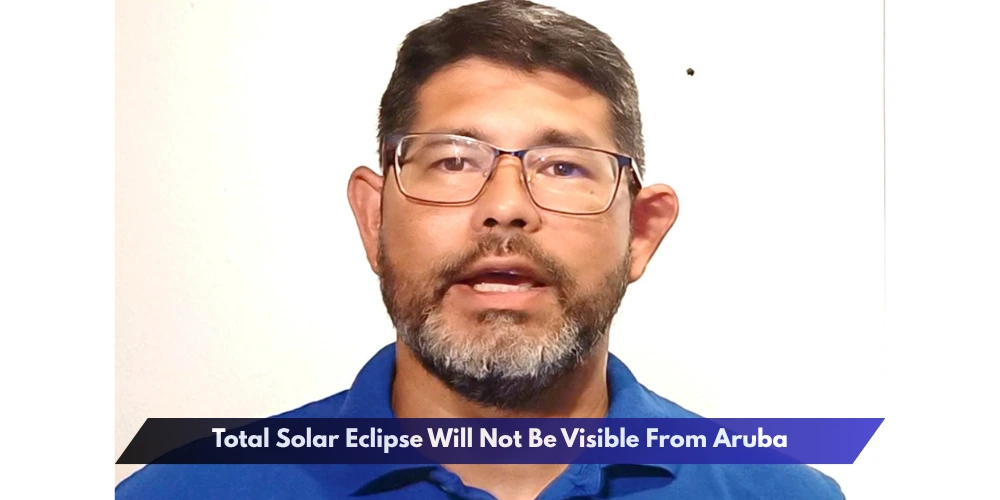
ORANJESTAD, Aruba – Solar Eclipse Not Visible From Aruba is the key message for residents interested in the total solar eclipse taking place on Wednesday, August 12, 2026. According to Jeremio Maduro of the Space and Nature Aruba Foundation, the astronomical event will not be observable directly from the island, although residents can still follow the eclipse through international livestreams.
The total solar eclipse is expected to darken portions of Greenland, Iceland, Spain and a small part of Portugal as the Moon passes between the Earth and the Sun. Those located within the path of totality will experience the Sun being completely covered for a brief period.
Maduro explained that Aruba is outside the eclipse’s viewing path, meaning residents will not see the solar eclipse from the island. However, people interested in following the event can watch live broadcasts online.

Several international organizations and astronomy platforms are expected to livestream the eclipse, including NASA. Residents can also search for “Live Eclipse 2026” on YouTube, where multiple channels are expected to provide live coverage from locations positioned within the eclipse path.
According to Maduro, people in Aruba can begin following online coverage from approximately 12:00 p.m. Aruba time, when many livestreams are expected to begin showing preparations and views of the astronomical event.
DIARIO also noted that Aruban scientist Dr. Edward Cheung is expected to be in Spain in an area where the eclipse will become visible. In Spain, the eclipse is expected to occur close to sunset, providing observers there with a distinctive view of the event.
Although the Solar Eclipse Not Visible From Aruba means local skywatchers will miss this particular solar event, residents will have another astronomical opportunity later in August.
Maduro announced that a partial lunar eclipse is expected to be visible from Aruba during the night of Thursday, August 27, into the early hours of Friday, August 28.
According to the information provided, approximately 96% of the Moon is expected to enter the Earth’s shadow during the event, creating a significant partial eclipse that residents should be able to observe directly from the island.
The lunar eclipse is expected to begin at approximately 10:48 p.m. on August 27 and continue until around 1:48 a.m. on August 28. The maximum phase of the eclipse is expected at approximately 12:12 a.m.
Observers will need to look upward toward the Moon during the event. Unlike a solar eclipse, a lunar eclipse can be viewed safely with the naked eye.
Maduro also explained that binoculars can be used safely to observe the lunar eclipse and may provide a clearer view of the Moon as it moves through the Earth’s shadow.
The Space and Nature Aruba Foundation plans to provide a livestream of the lunar eclipse through its Facebook page. This will give residents another viewing option if cloud cover prevents direct observation or if they prefer to follow the event from indoors.
The foundation continues to encourage interest in astronomy and natural phenomena by providing information and opportunities for the Aruba community to observe major celestial events.
While the total solar eclipse of August 12 will not be visible locally, residents can still experience it digitally and prepare for the partial lunar eclipse later this month.
The two events offer an opportunity for families, students and astronomy enthusiasts to learn more about the movements of the Earth, Moon and Sun while participating in international and local skywatching activities.