


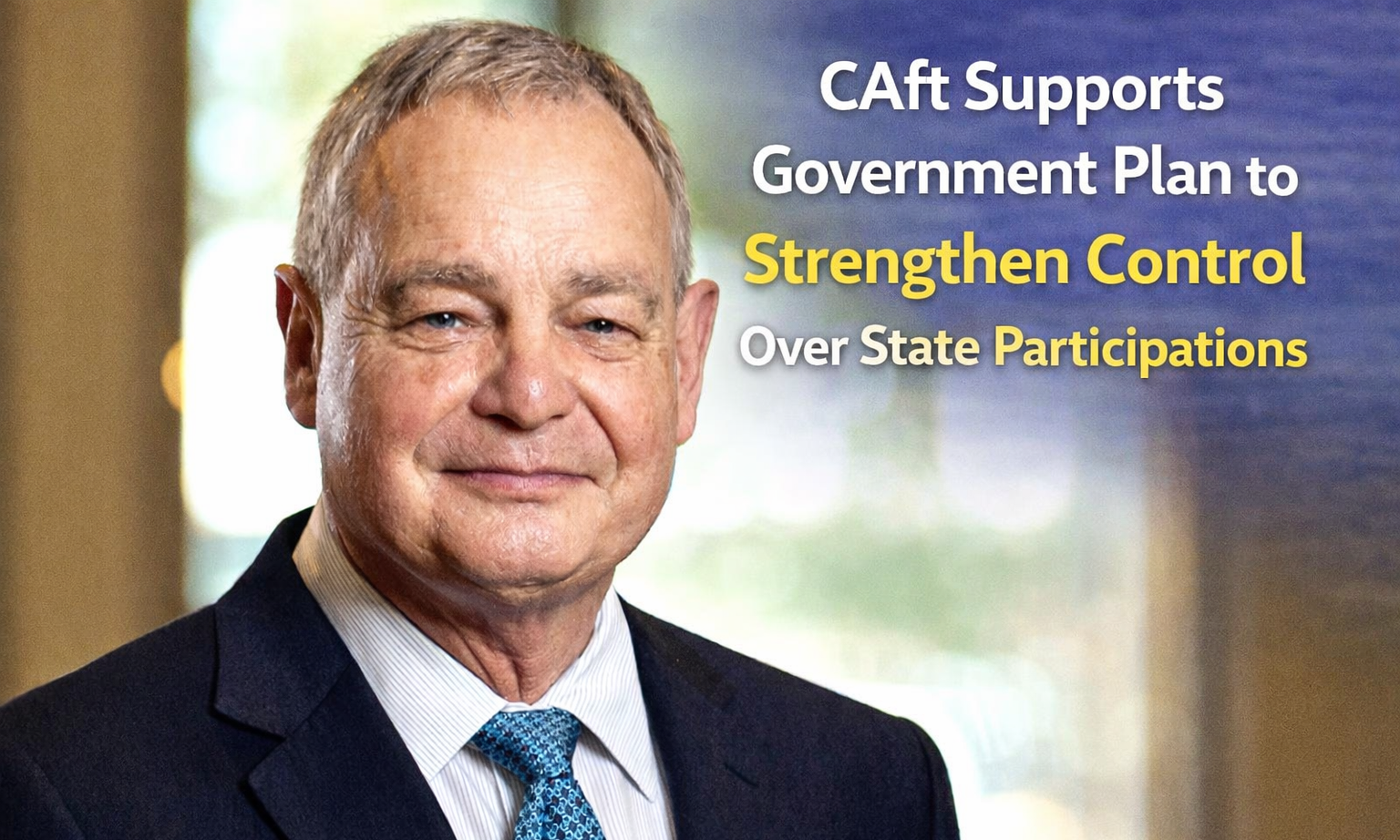
CAft Supports Government Plan to Strengthen Control Over State Participations The Financial Supervision Board of Aruba (CAft) considers it a positive development that Aruba intends to become the first country in the Caribbean part of the Kingdom to introduce a clear policy for the management of government participations and dividend distributions.
According to CAft, this policy — together with a new Corporate Governance Code — can help Aruba identify financial risks within state-owned companies at an earlier stage and improve both financial returns and social impact. However, CAft stressed that the effectiveness of this framework depends on proper implementation and consistent application in practice.
Policy on Government Participations
Companies in which the government holds shares are important for the country, but they also present financial risks. CAft referred to several examples:

-
Aruba Wastewater Sustainable Solutions (AWSS) intended to take on unnecessarily expensive loans.
-
Utilities Aruba distributed dividends without shareholder approval.
-
Financing and dismantling projects related to the Aruba Refinery (RdA) were carried out under unfavorable conditions.
In the case of AWSS, timely intervention occurred, partly based on CAft’s advice. CAft emphasized the importance of clearly defining roles: the Minister of Finance should act as shareholder on behalf of the government, line ministers should provide assignments, and companies should execute them. This structure ensures clarity regarding responsibility.
Aruba is currently implementing a participation policy, including rules on dividend payments. In addition, work is underway on the National Corporate Governance Ordinance. CAft considers these frameworks a strong foundation for improved management of state-owned enterprises, provided they are consistently enforced.
Concerns About Hospital Finances
CAft once again highlighted the financial risks surrounding Dr. Horacio Oduber Hospital (HOH). While the hospital’s costs fall under government responsibility, the government cannot intervene as owner or shareholder. CAft urged the government to reach a structural solution together with the hospital and its stakeholders to reduce financial risks.
RHOFA Law and Financial Benefits
Regarding the proposed Kingdom Act on Sustainable Public Finances Aruba (RHOFA), CAft stated that Aruba faces an important decision.
RHOFA and its related national ordinance provide a framework for financial supervision and offer significant financial benefits. Through RHOFA, Aruba could refinance existing foreign loans at lower interest rates through the Netherlands and secure new financing for investments at more favorable rates.
CAft estimates that this could generate interest savings of up to AWG 60 million per year — equivalent to more than AWG 500 per resident.
Financial Management Progress
CAft acknowledged Aruba’s progress in resolving delays in annual financial reports. The General Audit Chamber of Aruba has now received all annual accounts up to 2024. With reporting back on track, the next challenge is improving the quality of financial reporting.
On February 26 and 27, CAft visited Aruba and met with the Governor, Ministers of Finance, Economic Affairs, Justice, Integration and Public Transport, the Council of Ministers, Parliament, the General Audit Chamber, and state companies such as Utilities and the Aruba Refinery.
The photo accompanying the report shows Hans Hoogervorst, the new President of CAft.









Discussion about this post