

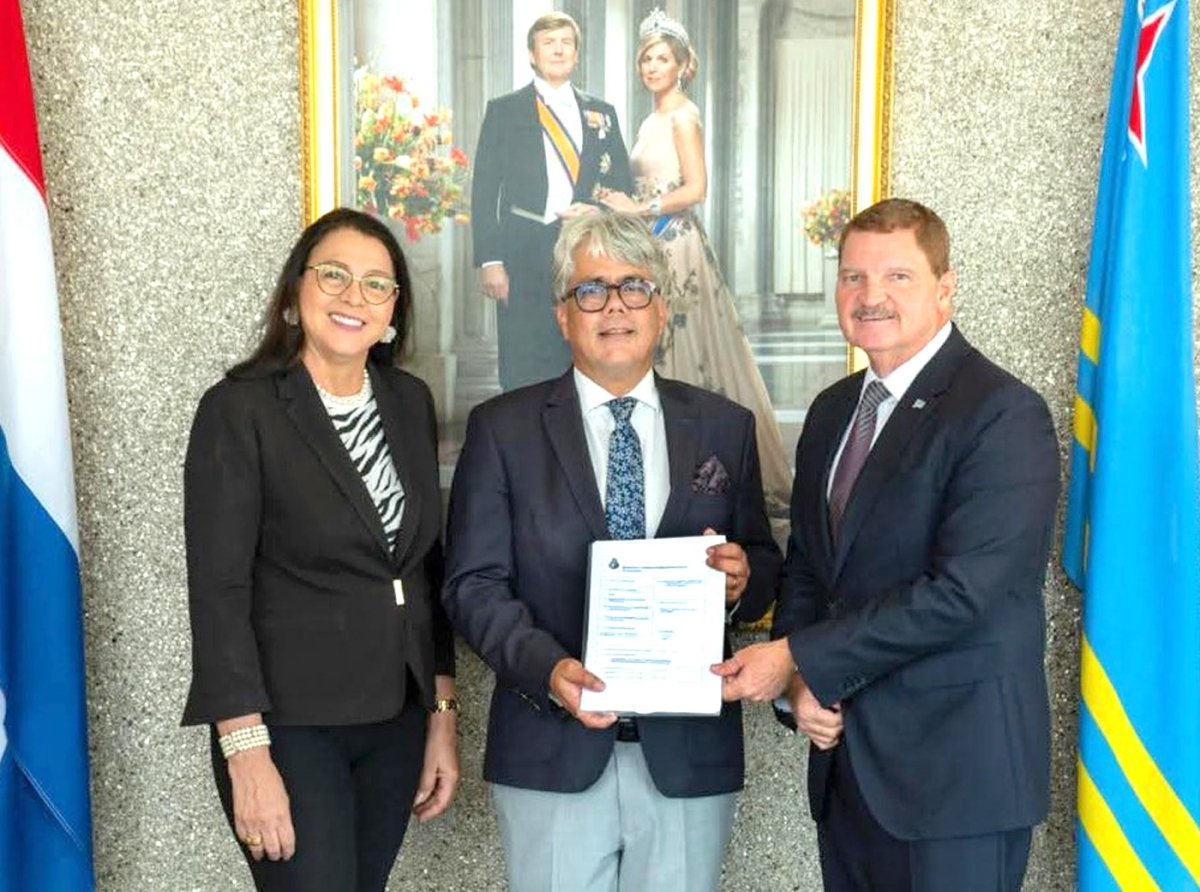
Prime Minister Mike Eman, together with Minister of Public Health, Social Affairs, Elderly Care and Addiction Mervin Wyatt-Ras, has announced two major legislative initiatives described as historic steps toward strengthening Aruba’s social foundation in a structural and long-term manner.
The proposed laws are the National Ordinance on Long-Term Care Aruba (Landsverordening Langdurige Zorg Aruba) and the National Ordinance for Compensation of Children Requiring Intensive Care. According to the government, both initiatives reflect a conscious policy choice by the AVP-Futuro Cabinet to anchor social care in sustainable legal and financial structures, guided by the principle of the common good.
Long-Term Care Law for Aruba
The Landsverordening Langdurige Zorg Aruba introduces, for the first time, a dedicated legal framework for long-term care on the island, particularly focused on elderly care. The law establishes a clear distinction between curative care, such as hospital treatment, and supportive long-term care, including care for seniors, individuals with chronic illnesses, and persons with physical or mental limitations.

Key elements of the law include a dedicated legal framework, a separate Long-Term Care Aruba Fund, and structural financing. Funding will be based on collective solidarity and initially supported through the allocation of existing portions of BBO and BAZV revenues. Execution and administration of the care system will fall under AZV, within a clearly defined legal framework.
Care will be provided based on objective assessments and organized into care packages, ranging from home-based care to full intramural care in residential facilities. The financing model is designed to be budget-neutral, relying on redistribution within existing financial resources without increasing overall financial pressure.
The government intends for this law to enter into force on January 1, 2027.
Compensation for Children Requiring Intensive Care
The second initiative focuses on families caring for children who require intensive and continuous care. The proposed National Ordinance for Compensation of Children Requiring Intensive Care provides a monthly financial compensation to families of children with one or more disabilities or medical conditions that demand intensive care.
This regulation is designed as an extension of existing social assistance legislation and forms part of broader social reforms aimed at protecting purchasing power. Based on budget discussions, the proposed compensation is expected to be approximately 500 florins per month per child. The government aims to implement this regulation as soon as possible during 2026.
The Common Good as a Guiding Principle
Both laws are explicitly framed within the principle of the common good, which the government identifies as a central guideline for public policy. The cabinet emphasized that serving the common good requires public responsibility, predictable structural financing, and durable institutional frameworks.
Drawing on the experience of entities such as AZV and the Aruba Tourism Authority, the government noted that public services with broad social value function best when supported by clear legal structures, stable funding, and professional execution. In this context, care—like tourism—is recognized as a pillar of the common good.
Prime Minister Mike Eman stated that the common good represents a moral and governmental responsibility to safeguard the dignity and well-being of the entire population. Minister Wyatt-Ras added that the new laws provide long-overdue recognition and support for elderly citizens and families caring for vulnerable children, offering security and dignity through structural, reliable solutions rather than temporary measures.
With the announcement of these two laws, the AVP-Futuro Cabinet positions Aruba toward a more humane, just, and future-ready social system. The proposed ordinances will be submitted to the Parliament of Aruba in the coming period for further consideration and debate.
Photo Credits : https://diario.aw/categories/noticia/general/gobierno-di-aruba-a-anuncia-dos-ley-historico















Discussion about this post