


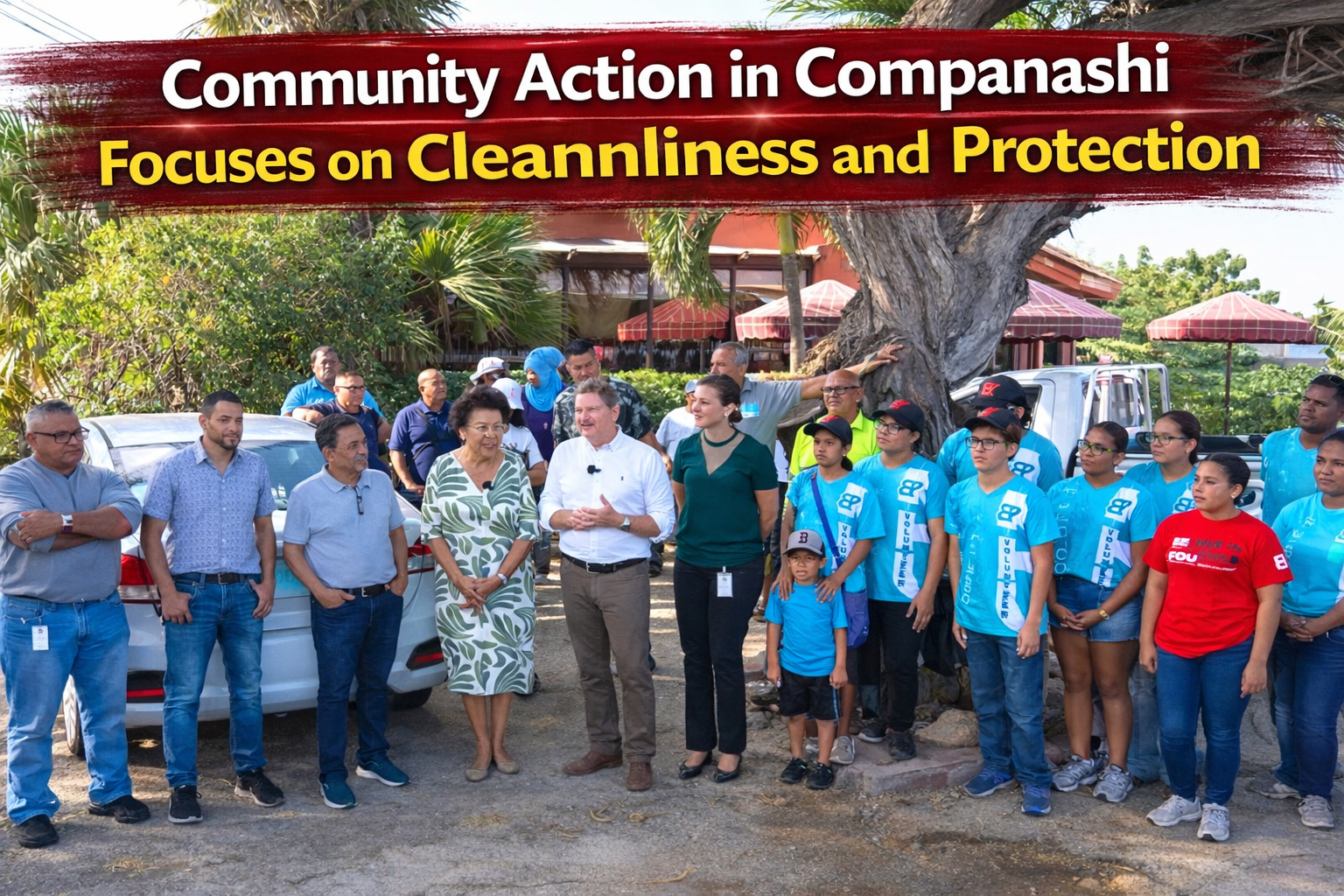
Accion di Bario na Companashi cu Limpiesa – During the Community Action in Companashi on Thursday morning, the Government once again left their offices to go directly into the community, listen to needs, and offer concrete assistance. The action began in front of Smith & Dorlas, where recognition was given to Ms. Ingrid Nicolaas, an entrepreneur who has been running her coffee shop with respect for the environment since the 1990s, ensuring the protection of trees surrounding her establishment.
In his remarks, Prime Minister Mike Eman emphasized the importance of combining economic development with respect for nature.
“We are working to strengthen the nature protection laws, including the creation of a new category for monumental trees—those that are very old and are part of our natural heritage,” the Prime Minister explained.

According to Prime Minister Eman, although Aruba has many trees, many of them are being cut down, putting pressure on the island’s natural heritage. The initiative to include “monumental trees” in legislation aims to preserve trees with historical, environmental, and cultural value for future generations.
The morning’s activities were not limited to environmental protection. In Companashi, an intergovernmental team—comprising DOW, Selimar, the Neighborhood Police, and various other entities—visited homes to assist with the removal of waste, old mattresses, furniture, and other materials that families, for various reasons including financial constraints, could not dispose of themselves.
The Prime Minister highlighted that the presence of all these entities together demonstrates the government’s commitment to a comprehensive approach: infrastructure, cleanliness, social welfare, and neighborhood sustainability.
Also present was Minister of Infrastructure René ‘Baba’ Herde, who emphasized that the needs in Companashi reflect a larger challenge faced by various neighborhoods across the island.
“Cleanliness is important, but when we visit neighborhoods, we see that the needs are much greater: social, medical, housing, and neighborhood renewal needs,” Minister Herde said.
Companashi serves as a clear example that neighborhoods require more structural attention, and the collaboration between various ministries is essential to addressing these needs.
The entire day was dedicated to visiting neighborhoods, listening to people, and offering concrete assistance. The central message was clear: the government does not wait for problems to arise but goes into the community to face them together with the citizens.
Through actions like this, Community Action continues to solidify its role as a direct tool for strengthening communities, improving quality of life, and connecting politics with the daily reality of the people.










Discussion about this post