


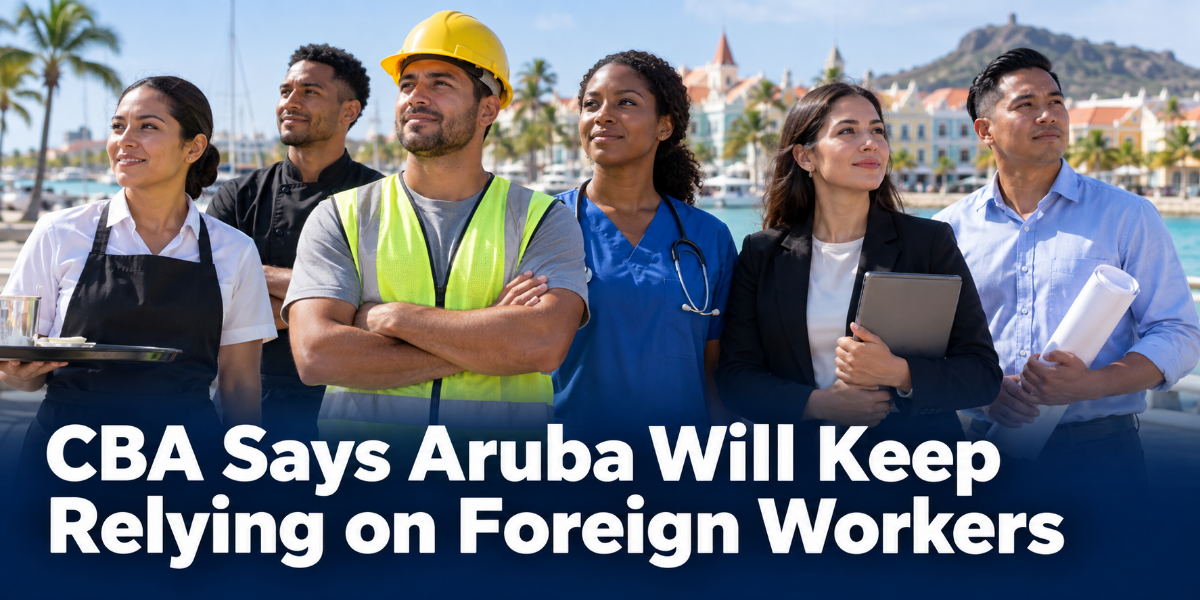
Aruba is likely to remain dependent on workers from abroad as labor shortages, an aging population and negative natural population growth limit the island’s domestic workforce, according to a new Central Bank of Aruba analysis.
The Aruba foreign workers assessment appears in a special section of the CBA’s September 2026 Economic Outlook. It examines how long-standing labor constraints and the regularization of undocumented migrants may affect the economy.
Labor demand continues to exceed local supply
The CBA said Aruba has historically relied heavily on foreign-born workers. Census data cited in the report show that in 2010, about 56 percent of employed people were native-born and 44 percent were born abroad.

More recent business surveys point to an increasingly tight market. In a 2024 Aruba Chamber of Commerce survey, 62 percent of companies described the severity of labor shortages as high, while 54 percent expected the shortage to worsen over the following one to two years.
The bank’s baseline forecast projects employment growth of 5.6 percent in 2026 amid strong tourism and construction activity. It says these conditions imply substantial reliance on imported labor, including workers needed to staff new hotel rooms.
Population trends add pressure
Aruba’s natural population growth—the difference between births and deaths—turned negative in 2025, the report said. Recent population increases have therefore depended primarily on migration.
The island is also aging. The old-age dependency ratio, which measures residents aged 65 and older relative to the working-age population, has more than doubled since 2005. The CBA said a larger working-age population will be needed to help finance and provide healthcare and elderly-care services.
Regularization may have a limited effect on vacancies
The analysis notes reports that about 5,800 permits were granted through the Hunto Pa Progreso regularization process, including approximately 1,600 temporary permits. Formalizing people already working informally could expand the tax and social-contribution base and improve working conditions.
However, the bank cautioned that moving existing workers from the informal economy into formal employment does not necessarily fill open positions. As a result, the program’s immediate effect on current labor shortages may be limited, even while it brings other economic and social benefits.
Policy choices remain important
The report does not present foreign recruitment as the only response. Its findings indicate that labor policy, housing, healthcare capacity, worker integration and enforcement will all influence the costs and benefits of a larger formal workforce.
For Aruba, the central conclusion is demographic as much as economic: without enough locally available workers to meet demand, labor supply from abroad is expected to remain an important part of future growth.
Sources: The Central Bank of Aruba’s September 2026 Economic Outlook and reporting from 24ora.