

ORANJESTAD, Aruba — The Aruba Crisis Preparedness Plan is moving into a new phase after Prime Minister Mike Eman received recommendations from a team that worked with local professionals to review and strengthen the island’s ability to respond to potential emergencies.
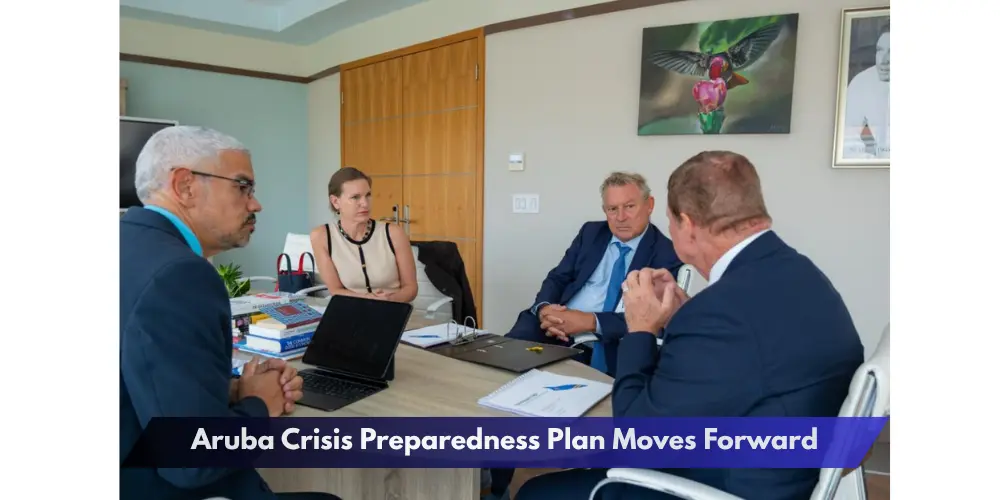
Eman met with a delegation that presented an overview of work carried out during the latest phase of Aruba’s crisis-preparedness efforts.
The process began during a period of heightened tensions between Venezuela and the United States, when the Aruba government decided additional preparation was needed to reduce the risk of being caught unprepared by possible regional developments.

Aruba subsequently requested support from the Netherlands in the form of additional crisis-management expertise.
Aruba Crisis Preparedness Plan Gets Dutch Support
The Netherlands responded to Aruba’s request by making crisis-management expertise available.
John van der Zwan worked closely with Aruba’s Crisis Management Office, or CMO, and local professionals during the assessment.
The approach combined outside experience from within the Kingdom with knowledge of Aruba’s local institutions, infrastructure and circumstances.
During the meeting with Eman, Van der Zwan was joined by Joke Vroegop and Johnson, an Aruban professional working with the Dutch Ministry of the Interior and Kingdom Relations.
They discussed the work carried out and recommendations developed during the process.
Current reporting confirms that the government intends to use those recommendations to strengthen coordination, training and Aruba’s ability to respond to emergencies.
Eman Says Preparedness Requires Continuous Work
Eman said Aruba already has a strong reputation within the Kingdom and the region for its level of emergency preparedness and ability to respond to exceptional situations.
However, he stressed that crisis readiness cannot be treated as something that is ever completely finished.
Even when institutions are well prepared, procedures, training and coordination can continue to improve.
The objective, according to Eman, is to ensure Aruba’s communities, institutions and professionals prepare and train together so they can respond effectively when an unexpected situation occurs.
Recommendations Enter Implementation Phase
The next stage of the Aruba Crisis Preparedness Plan will focus on implementing recommendations prepared by Van der Zwan’s team together with local professionals.
The government said it will continue working with relevant partners to improve coordination between organizations, strengthen training and increase response capacity.
Specific recommendations have not yet been publicly detailed.
Current reporting also does not identify particular weaknesses found during the review or disclose every crisis scenario examined.
The government’s public emphasis remains on strengthening overall readiness rather than responding to one specific threat.
Crisis Management Already a Continuing Priority
Aruba has undertaken several crisis-management initiatives during 2026.
In April, Eman and CMO reviewed ongoing crisis-preparedness work, Kingdom cooperation and Aruba’s strategic position within the region.
More recently, CMO has emphasized the importance of reliable information during emergencies and stronger public participation in national evacuation exercises.
Aruba also participated in the Caribbean Kingdom Crisis Management Week in The Hague in June, where crisis-management professionals from across the Kingdom conducted exercises and exchanged expertise.
These initiatives reflect a broader effort to keep emergency-response systems active rather than waiting until a crisis occurs.
Government Emphasizes Prevention and Cooperation
Eman thanked Van der Zwan, local professionals and partners within the Kingdom for contributing to the assessment.
For the government, the Aruba Crisis Preparedness Plan is intended to go beyond responding after an emergency has already developed.
The strategy emphasizes anticipation, exercises, coordination and preparation before a serious situation arises.
As Aruba begins implementing the latest recommendations, the government says continued cooperation between CMO, public institutions, local professionals and Kingdom partners will remain essential to strengthening the island’s resilience and emergency response.