


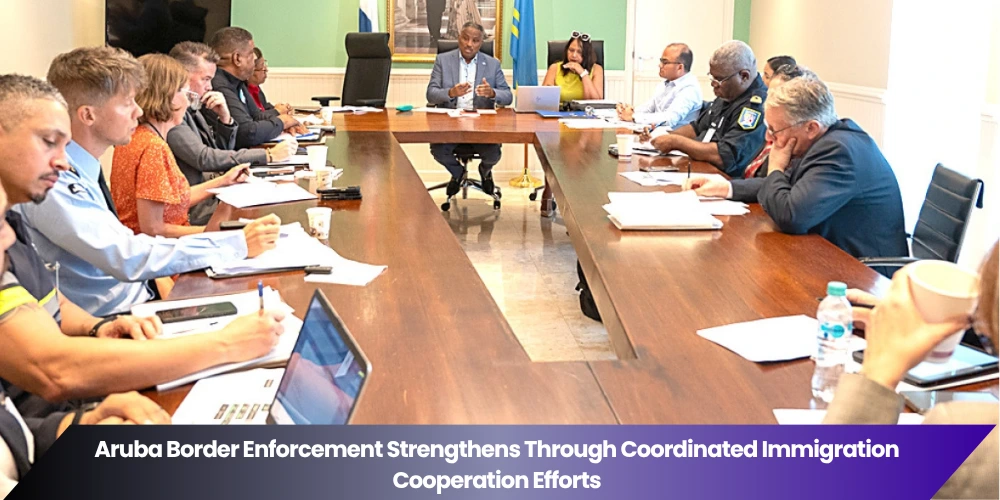
ORANJESTAD, Aruba — Aruba Border Enforcement is being strengthened through closer cooperation among government departments responsible for immigration, customs, policing and coastal security.
Justice, Integration, Public Transport and Energy Minister Arthur Dowers met Wednesday morning with representatives from Aruba’s border-supervision chain to discuss the current state of border controls, migration administration and enforcement involving people without legal residency status.
The meeting formed part of continuing government efforts to modernise immigration enforcement and improve operational coordination among agencies protecting Aruba’s borders.

Minister Presents Strategic Priorities
Dowers presented an update concerning the Hunto pa Progreso programme and outlined strategic priorities established by the government for strengthening the migration-enforcement system.
Representatives from the participating agencies discussed current developments, operational concerns and difficulties affecting their daily responsibilities.
The minister said effective border management depends on continuous communication and clear coordination rather than individual departments operating separately.
He emphasised that every organisation within the enforcement chain must understand its responsibilities and share relevant information when legally permitted.
Multiple Agencies Attend Border Meeting
Representatives attending the meeting included:
- The Border Supervision Progress Committee;
- The Department of Legal Affairs and Legislation;
- The Dutch Caribbean Coast Guard;
- DIMAS;
- Aruba Customs;
- The Aruba Police Force;
- Aruba Immigration;
- Bureau Guarda Nos Costa;
- The Office of the Justice Minister;
- The Office of the Finance Minister.
Each organisation performs a different role within Aruba’s border, immigration or enforcement system.
Immigration officials manage the movement of travellers at authorised entry points, while DIMAS handles residence and admission matters. Police, customs and coastal-security bodies also contribute to detecting illegal entry, prohibited goods and other possible violations.
Aruba’s Immigration Department is based in Oranjestad and forms part of the government structure responsible for migration services and compliance with immigration requirements.
Coordination Considered Essential
Dowers said strong coordination is necessary to create a border-supervision system that is efficient, modern and effective.
A person or incident may involve several agencies at different stages.
For example, immigration authorities may identify an overstay, DIMAS may review the person’s legal status, police may become involved in enforcement, and another department may handle removal or administrative procedures.
Without communication, cases can be delayed or transferred between departments without a clear outcome.
The government therefore wants stronger operational agreements, shared priorities and clearer working relationships among participating organisations.
Hunto pa Progreso Included in Discussion
The minister also updated the agencies on Hunto pa Progreso, a programme previously established to address the situation of certain people living or working in Aruba without regular status.
The government said earlier in 2026 that registration had already ended but that DIMAS, with support from the International Organization for Migration, was still matching eligible applicants from one programme pathway with employers.
Approximately 1,500 registered participants were reportedly being given time to find an employer and enter the regular permit process if they met all requirements.
The latest meeting did not announce a new registration period or expand eligibility.
Its purpose was to review the programme’s status alongside the government’s broader migration and enforcement priorities.
Enforcement Against Illegal Activity
Dowers previously said administrative controls would be intensified involving overstays, undocumented employment and people or businesses facilitating unlawful situations.
Those controls could include attention to employers hiring workers without authorisation, guarantors connected to visitors who overstay and other activities conducted without the necessary legal permits.
The government has argued that immigration enforcement should apply not only to people without status but also to individuals or organisations that knowingly enable illegal employment, accommodation or commercial activity.
The present announcement does not identify specific businesses or individuals under investigation.
Border Security Extends Beyond Airports
Aruba’s border-supervision system covers more than immigration desks at Queen Beatrix International Airport.
The island must also supervise maritime approaches, cargo, ports and movements involving small vessels.
Previous government cooperation involving immigration, police, customs, the Coast Guard and other authorities has focused on irregular migration, cross-border crime and faster information exchange.
Maritime agencies can identify suspicious vessels or unauthorised coastal arrivals, while customs officers inspect goods and police investigate possible criminal offences.
Effective border management therefore requires land, air and sea operations to function as parts of one connected system.
Modernisation Remains a Government Priority
The government’s stated objective is to develop border supervision that is faster, more intelligent and more effective.
Modernisation may involve technology, updated procedures, better staffing arrangements and improved data exchange.
However, the July meeting announcement did not identify a new technology purchase, budget allocation or confirmed infrastructure project.
Any future operational changes will require further planning, legal review and cooperation among the responsible departments.
Legal Status Requires Individual Review
People without legal residency status do not all have identical circumstances.
Some may have overstayed an authorised visit, while others may have pending applications, employer-related cases or other legal matters requiring individual review.
Government agencies must apply Aruba’s laws while respecting applicable procedures and privacy protections.
Participation in Hunto pa Progreso also does not automatically guarantee permanent residency or an unrestricted work permit. Applicants must satisfy the conditions connected to their individual programme pathway and the regular admission process.
Shared Vision for an Orderly System
Dowers said only close cooperation, continuous communication and a shared vision can maintain secure borders and an orderly migration system.
The meeting placed responsibility across the entire enforcement chain rather than on a single organisation.
Immigration, DIMAS, police, customs, coastal authorities, legal advisers and government ministries must work together when cases involve overlapping responsibilities.
The Aruba Border Enforcement initiative therefore focuses on coordination as the foundation for stronger supervision and more consistent application of migration laws.
Further announcements will be required before the public can evaluate which specific operational changes, enforcement measures or legislative proposals result from the meeting.