

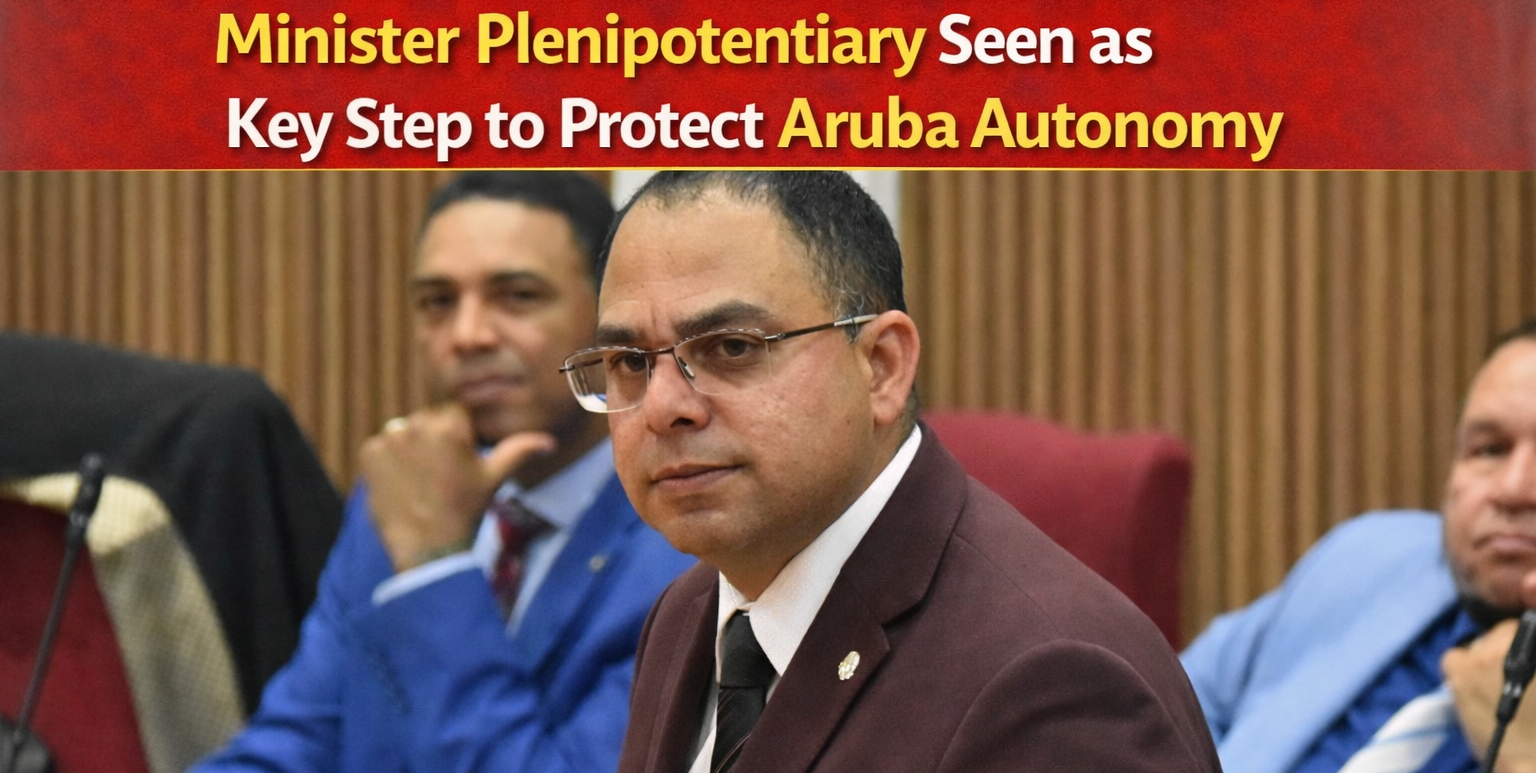
The appointment of a Minister Plenipotentiary Aruba autonomy in the Netherlands is an essential step to safeguard the island’s autonomy within the Kingdom of the Netherlands, according to parliamentarian Eduard Pieters of the PPA party.
Pieters explained that the role is not merely an administrative appointment but a constitutional responsibility that directly affects Aruba’s position within the Kingdom.
Constitutional Role Within the Kingdom
The position of Minister Plenipotentiary is defined in the Statute of the Kingdom of the Netherlands (Statuut voor het Koninkrijk der Nederlanden). Under this framework, each autonomous country within the Kingdom must have a representative in The Hague.

The Minister Plenipotentiary participates in the Rijksministerraad, the Kingdom Council of Ministers where important decisions concerning the Kingdom are discussed and approved.
According to Pieters, the role is crucial because it ensures that Aruba’s interests are represented during discussions involving constitutional, financial, and political matters that affect the Kingdom as a whole.
Political Debate Delayed the Appointment
Pieters noted that the appointment came after prolonged political debate and pressure, particularly involving the governing coalition parties AVP and Futuro.
In the past, some political leaders argued that the position was unnecessary and too costly for Aruba, suggesting that the country could operate without a Minister Plenipotentiary in the Netherlands.
However, the recent decision to restore the position indicates that a compromise was ultimately reached.
“For the PPA faction, this confirms what we have argued from the beginning: Aruba cannot ignore its constitutional responsibilities as an autonomous country within the Kingdom,” Pieters stated.
Confidence in New Representative
Pieters also expressed confidence in Milly Schwengle, who has been appointed to the position. Schwengle previously worked for many years with the Raad van State, one of the central legal institutions within the Dutch constitutional system.
According to Pieters, her experience provides significant advantages, including deep knowledge of constitutional procedures, familiarity with political culture in The Hague, and understanding of relations between the countries of the Kingdom.
Protecting Aruba’s Autonomy
The appointment comes at a symbolic time as Aruba marks 40 years of Status Aparte, a milestone in the island’s political development and autonomy.
Pieters emphasized that the Minister Plenipotentiary must play a strong role in defending Aruba’s autonomy when discussions arise regarding financial cooperation, Kingdom legislation, and diplomatic relations.
He concluded by wishing Schwengle success in the position, stating that Aruba needs a representative who can defend the country’s interests with knowledge, dignity, and determination.
At the same time, Pieters noted that the political debate leading up to the appointment raises broader questions about the direction of governance, emphasizing that fundamental constitutional matters should not shift repeatedly based on political disagreements.