

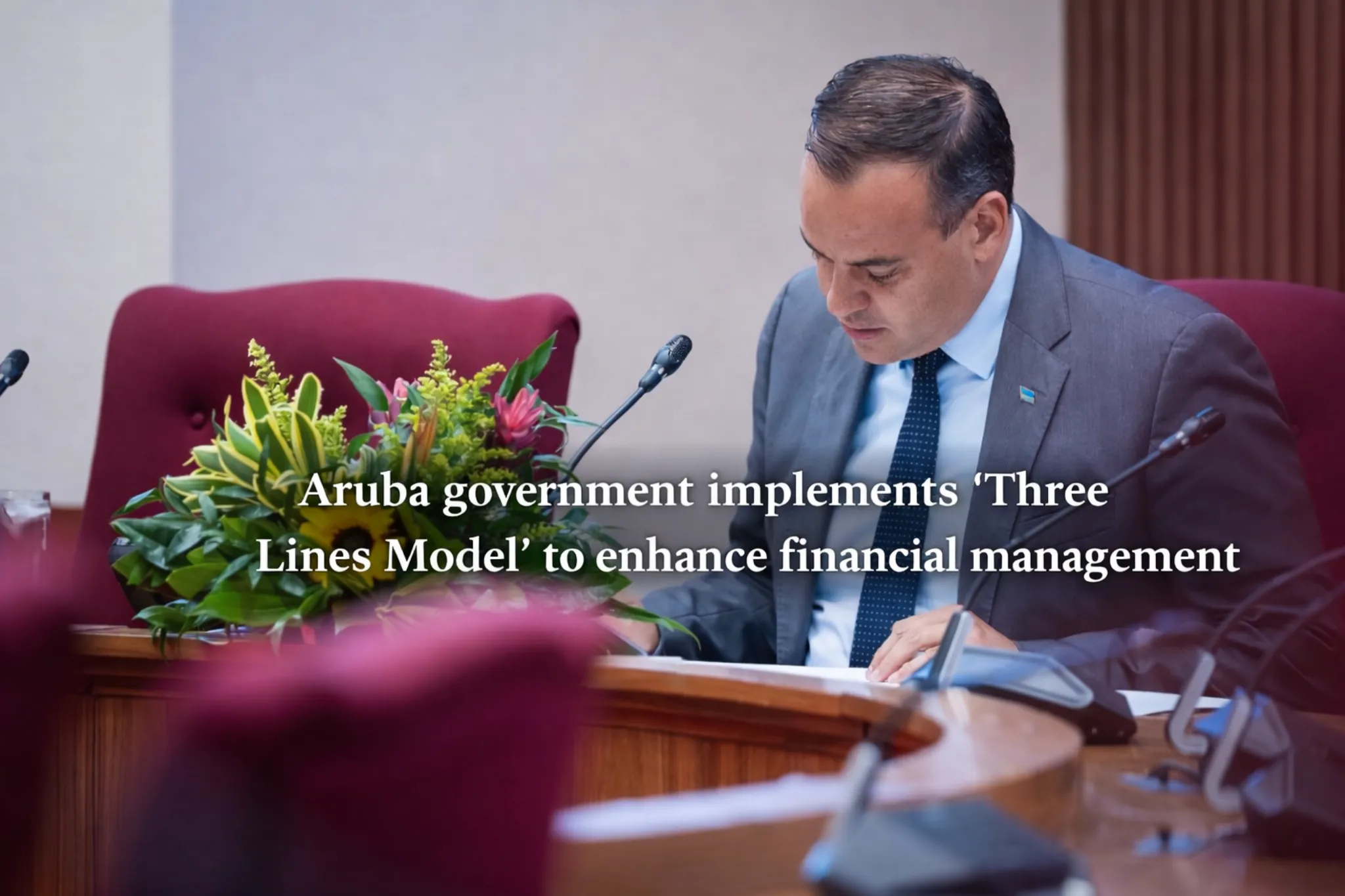
ORANJESTAD (AAN) – Minister of Finance, Economic Affairs, and Primary Sector, Mr. Geoffrey Wever, recently presented to Parliament a comprehensive update on the implementation of the Three Lines Model (3LM). This key initiative is part of the Landspakket Issue, aiming to strengthen Aruba’s public finance management and ensure that the government remains “in control.”
The Three Lines Model represents a significant step in government modernization, focusing on clarity of responsibility, effective internal controls, and financial transparency. In the new structure, the first line (each department) takes direct responsibility for risk management and control of daily operations; the second line, led by the Steunpunt Internal Beheersing (SIB), strengthens oversight and provides professional guidance; while the third line, managed by the Centrale Accountantsdienst (CAD), ensures independent control and quality audits.
By 2026, significant progress has been made in implementing the model. Of the ten central financial processes that are part of the reform, six are fully operational, with trained personnel working in a modernized and standardized system. The model has been adopted by 15 government departments, representing the largest share of government spending and directly impacting the nation’s financial management.

A critical element of the reform is the legal consolidation of the model. Currently, a landsbesluit is in the final phase, which will clearly define the role and responsibilities of each line, providing a strong foundation for the model’s sustainability. The Raad van Advies has already provided its advice, and the final version will soon be presented to the Council of Ministers for approval.
The government has also taken decisive steps to strengthen institutional capacity by formally establishing the SIB as part of the Financial Directorate, with a focus on monitoring, coaching, and guiding various public services. Alongside this, human capital investment remains a priority, with the introduction of the digital program E-LOFA, which has already enrolled 99 employees, with 68 completing the program, thereby enhancing their competence in public financial management.
Minister Geoffrey Wever emphasized that the Three Lines Model is aligned with the vision of the AVP-FUTURO Government Program 2025-2028, which prioritizes good governance, financial discipline, and transparency for long-term economic growth.
“We are working systematically to create a government based on control, responsibility, and trust,” Minister Wever stated. “The Three Lines Model represents not just a technical reform, but a fundamental shift in the culture of public management, where decisions are based on control, transparency, and results.”
Despite significant progress, Minister Wever acknowledged the challenge of the shortage of qualified personnel in the financial sector. To address this, the government has adopted a combination of solutions, including temporary outsourcing of some audit functions from 2026 to 2028, while simultaneously investing in personnel recruitment and on-the-job training to enhance internal capacity.
The Three Lines Model underscores the government’s commitment to advancing structural reforms in public finance to ensure a reliable, efficient, and transparent government that contributes to economic stability, international trust, and the well-being of Aruba’s citizens.













Discussion about this post