


There are many silent issues that people tend to avoid talking about, one of which is colon cancer.
It is a clinical area. Complicated. Uncomfortable. For many years, colon cancer screenings have been linked with hospitals, medical preparation, procedures, and fear. For many men and women in Aruba, the thought of screening only refers to a colonoscopy. Therefore, many prefer to wait.
This perception is what the Fundación ABO (Aruba Population Screening Foundation) aims to change with their campaign for the CORESA colon cancer screening program during the month of March. March is the International Colon Cancer Awareness Month, and this year, the goal is not only to raise awareness but also to introduce the next step: the FIT Test.

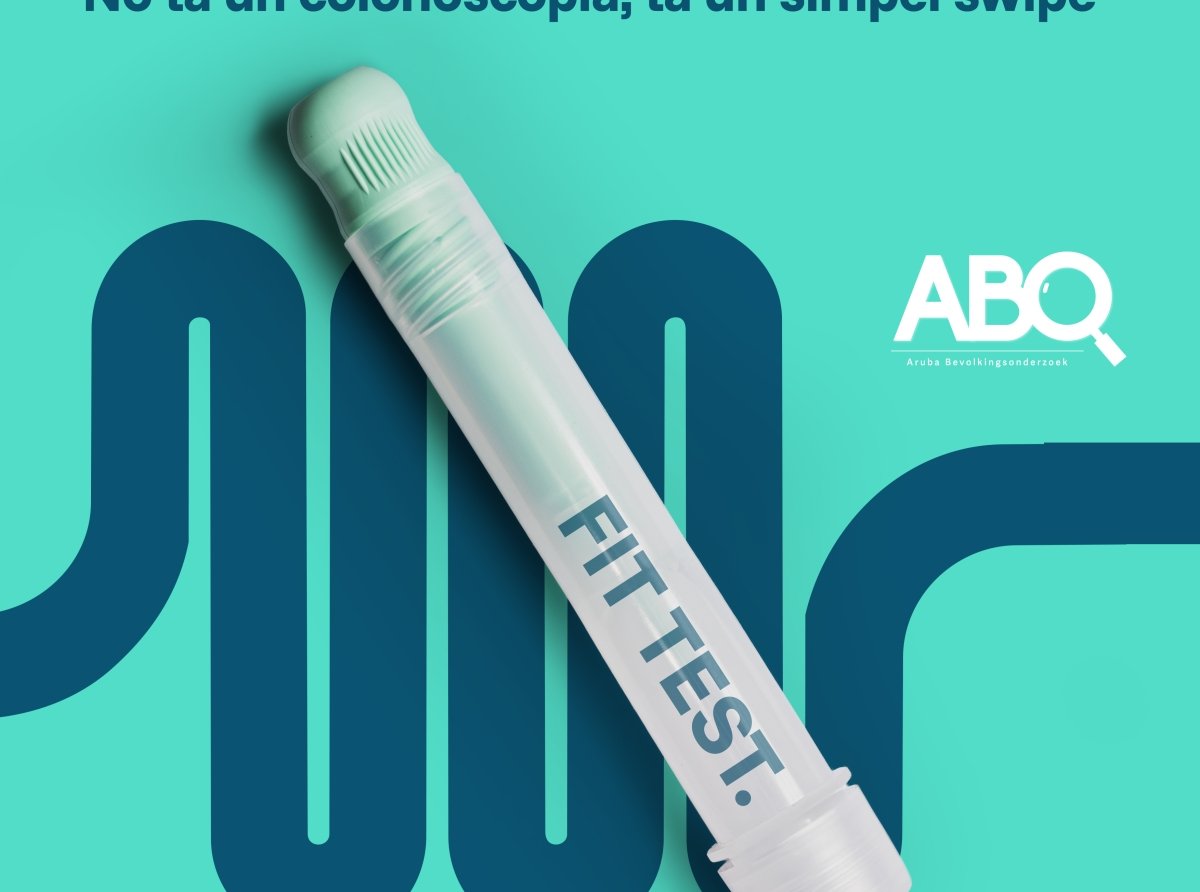
The FIT Test (Fecal Immunochemical Test) is a simple screening tool that can be done at home. Using this method, you collect a small sample, which is then sent to the lab for analysis. No need to visit a hospital, no preparation required, and no anesthesia.
This test checks for the presence of invisible blood in the stool, which is an early sign of cancer. If detected early, it can change the entire outcome.
The majority of people avoid screenings due to fear—fear of diagnosis, fear of the procedure, and fear of what it might mean. The FIT Test aims to eliminate these fears, step by step.
The test separates screening from hospitals, prevention from panic, and it brings the first step back to the privacy of your home.
Dr. Chris Franca, gastroenterologist and founder of the program, simply explains, “Screening doesn’t start with a colonoscopy. It starts with a simple FIT test at home. Once we eliminate unnecessary barriers, more people are willing to participate. Early detection saves lives.” Colonoscopy remains an important medical tool, but it should only be considered if the FIT test shows that further evaluation is needed. For most people, the FIT test is the only step necessary.
Men and women aged 45 to 75, covered by AZV (Aruba’s Health Insurance), are eligible for the screening. No doctor’s referral is required. Some will receive an invitation letter from Fundación ABO by mail, not as advertising, but as an invitation for prevention. Others can contact the foundation directly.
Eligibility will be verified, and screenings will be coordinated at convenient locations such as the Lab HOH or the Fundación ABO office, which now offers extended hours on Wednesday evenings and Saturday mornings.
Throughout the month of March, Fundación ABO’s presence will be notable across Aruba, with radio interviews, television programs, community talks, and health sessions at workplaces. Information booths will be available at pharmacies like BENU, ImSan, HOH, and other strategic pop-up locations. At many of these events, eligible residents can register and receive their FIT test kit.
Nanine Ponson, Director of Fundación ABO, sees this not as a campaign but as infrastructure: “When prevention is structured and accessible, participation becomes the norm. It becomes part of how we care for ourselves and others. We see our community responding with seriousness and unity.”
Perhaps this is the most powerful change: screening for colon cancer doesn’t have to be something whispered about. It should be a regular, responsible practice. It’s a small act of care, done in the privacy of your home, before symptoms appear. Screening is designed for people who feel healthy.
It’s not about fear. It’s about early action. And for Aruba, that action starts with something simple— a small kit, a quiet moment at home, and a decision that says: I choose prevention.
For more information or to verify your eligibility:
Phone: +297 588 1212
WhatsApp: +297 594 5020
You can also register online: fundacionABO.org/BoAf













Discussion about this post