


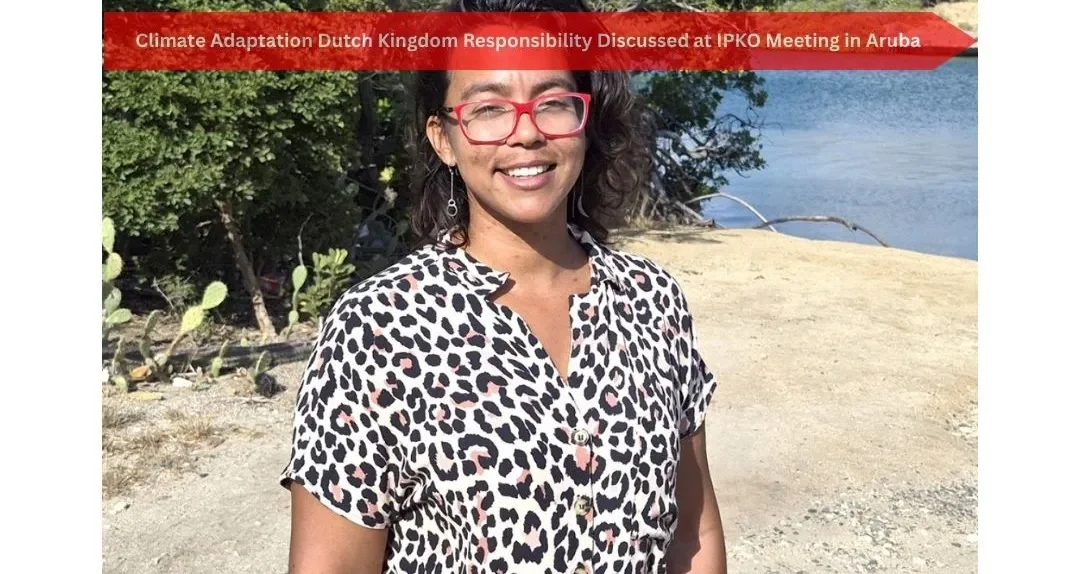
ORANJESTAD (AAN): The issue that Climate Adaptation Dutch Kingdom Responsibility was highlighted during the recent Interparliamentary Kingdom Consultation (IPKO) held in Aruba, where climate activist Oriana Wouters addressed representatives about the importance of shared responsibility across the Kingdom of the Netherlands.
Wouters, who represents the Climate and Social Justice Group of the Dutch Caribbean, explained that climate adaptation should not be seen as a responsibility of the Netherlands alone but rather as a shared obligation of the entire Kingdom.
During her presentation, she emphasized that Climate Adaptation Dutch Kingdom Responsibility must include Aruba, Curaçao, Bonaire, and other Caribbean islands that face increasing environmental risks related to climate change.

One of the key points raised by Wouters concerned the situation in Bonaire, where a court ruling determined that the Dutch government had acted in a discriminatory manner in its climate policy toward the island. According to the ruling, climate measures established in the Netherlands were not equally applied in the Caribbean parts of the Kingdom.
Wouters pointed out that the Statute of the Kingdom of the Netherlands contains provisions that guarantee the protection of fundamental rights across the Kingdom. These provisions, often referred to as safeguard functions, indicate that all parts of the Kingdom share responsibility for ensuring that the rights of citizens are protected.
She stressed that climate change policies must respect and protect the fundamental rights of people living on the islands, including their safety, environment, and living conditions.
Another issue raised during the discussion was recent climate-related initiatives within the Kingdom. Wouters mentioned the involvement of The International Panel on Deltas and Coastal Areas (IPDC), which has helped Caribbean islands assess climate scenarios and develop strategies for future adaptation.
According to Wouters, the time has come for each country within the Kingdom to develop its own climate adaptation plan that addresses the specific environmental challenges faced by the islands.
However, she also highlighted the challenge of limited financial resources available for climate adaptation projects. Technical support and funding are still needed to implement many of the proposed measures.
Wouters argued that the Kingdom should take greater responsibility for ensuring that climate resilience initiatives are properly supported, especially since these projects are carried out in the interest of the entire Kingdom.
She also explained that Caribbean islands within the Kingdom have a special position in international climate agreements, including funds related to climate loss and damage. Because the islands themselves did not sign certain international agreements while the Netherlands did, they often depend on the Netherlands to access climate funding.
Wouters suggested that small changes in Dutch funding frameworks could help improve access to climate resources. For example, adjustments to the Rijkscultuurfonds law could allow climate projects that protect cultural and natural heritage to receive funding.
According to Wouters, enabling local organizations to access such funds would allow climate initiatives to be developed according to each island’s unique identity and needs.














Discussion about this post