

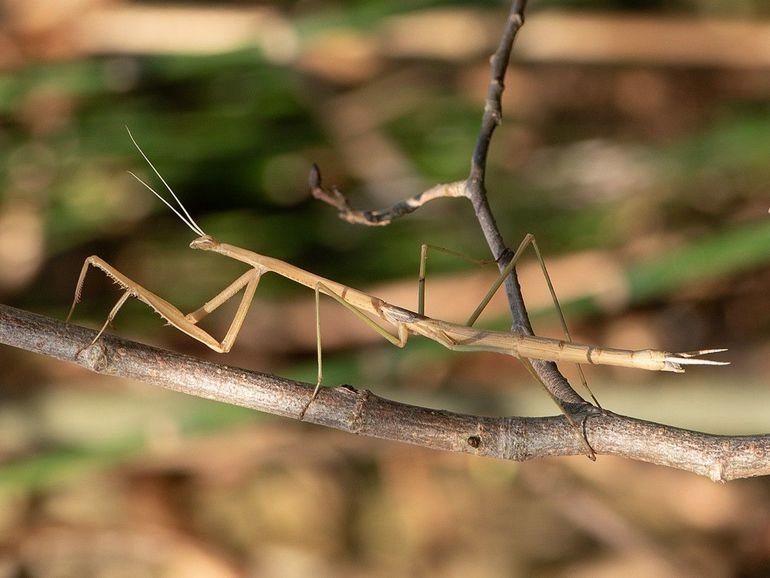
A major scientific breakthrough has been announced with the Aruban praying mantis discovery, confirming the existence of a new insect species found on the island.
In 2025, volunteers from Naturalis Biodiversity Center and members of the Dutch Entomological Society collected several specimens of a praying mantis in Aruba. Further research confirmed that the Aruban praying mantis discovery represents a species previously unknown to science.
The newly identified species has been named Brunneria xerophila, commonly referred to as the Aruban praying mantis. The name reflects its adaptation to Aruba’s dry and warm environment, as the term “xerophila” means “lover of dryness.”

The Aruban praying mantis discovery is particularly significant because no mantis species had ever been officially recorded on Aruba, Bonaire, or Curaçao before. Initial signs of its existence came from photos shared online, but scientists were unable to confirm the species until physical specimens were collected.
Measuring nearly 7 centimeters in length, the insect is considered one of the largest insects found on the ABC islands. Like other mantises, it is known for its triangular head, folded front legs used for hunting, and its “prayer-like” resting position.
Researchers believe the Aruban praying mantis discovery may indicate that the species is more widespread across the island than currently documented, although further field studies are needed to confirm its distribution, including nearby regions such as Venezuela.
This discovery is part of ongoing collaboration between the Aruba Conservation Foundation and Naturalis to better understand the island’s biodiversity. The Aruban praying mantis discovery adds to a growing list of newly identified species in Aruba, including insects such as grasshoppers, spiders, and true bugs.
Scientists emphasize that findings like the Aruban praying mantis discovery highlight how much remains unknown about Aruba’s natural environment and the importance of continued research and conservation efforts.















Discussion about this post