

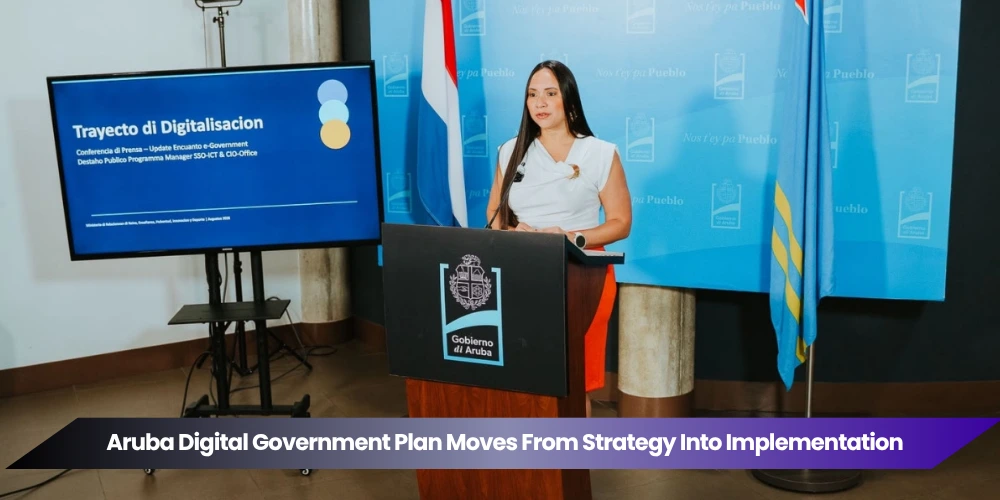
ORANJESTAD — Aruba is moving forward with the next phase of its Aruba digital government, as the government prepares to connect public services, strengthen cybersecurity and create a more coordinated ICT structure across departments.
Minister Gerlien Croes said the government is following a step-by-step approach to build a more sustainable digital public administration in which systems can communicate securely, citizens can rely on trusted digital identity, and departments can work under common ICT standards.
As part of the next phase, government is preparing a pilot project to connect several public services.

The goal is to allow information to be exchanged securely and directly between participating institutions, reducing paperwork, delays, duplicated work and inconsistent information.
The first phase is expected to connect DIMAS, CENSO and IMPUESTO.
If the pilot proves successful, the model will gradually be expanded to additional departments and services.
Government ICT Currently Fragmented
According to the government, ICT operations are currently highly fragmented.
Different departments often maintain their own systems, contracts, licenses and suppliers. This can make coordination more difficult, increase dependency on external providers and create avoidable costs.
To improve coordination, Aruba is proposing two separate but closely connected structures.
The CIO Office would provide strategic direction and establish common policies and standards for ICT, cybersecurity, data, cloud services and innovation.
The SSO-ICT structure would focus on operational delivery of shared ICT services, including digital infrastructure, workplace technology, contracts, suppliers and software licensing.
Program Manager Sought
Government has opened a public tender for a Program Manager who will help structure and coordinate the development of the SSO-ICT and CIO Office.
The deadline to apply is August 28, 2026, at 11:59 p.m. AST.
Applications can be submitted by email to:
aanbestedingen.kojis@arubagovernment.aw
The Program Manager is expected to coordinate the organizational, technical and human aspects of the transition.
The government emphasized that the role is not intended only for a technical ICT specialist. Experience with organizational change, governance and restructuring is also considered important.
Digital Transformation Also Requires People
Croes stressed that technology alone cannot transform government.
The employees who use, manage and continue developing digital systems are equally important.
Government is therefore working with DRH on recruitment, training, development and retention of ICT professionals.
Strengthening internal expertise is intended to reduce dependence on external suppliers and ensure that essential knowledge remains inside the public sector.
From Planning to Execution
The current direction was developed further during a January 2026 “pressure cooker” session supported by TWO Netherlands.
Government says the preparation phase is now moving toward implementation, with clearer responsibilities, priorities and measurable results.
The long-term objective is to create a digital government strategy that does not depend on one project, one system or one supplier.
Instead, Aruba wants to build internal capacity to maintain, secure and continue improving digital public services over time.