


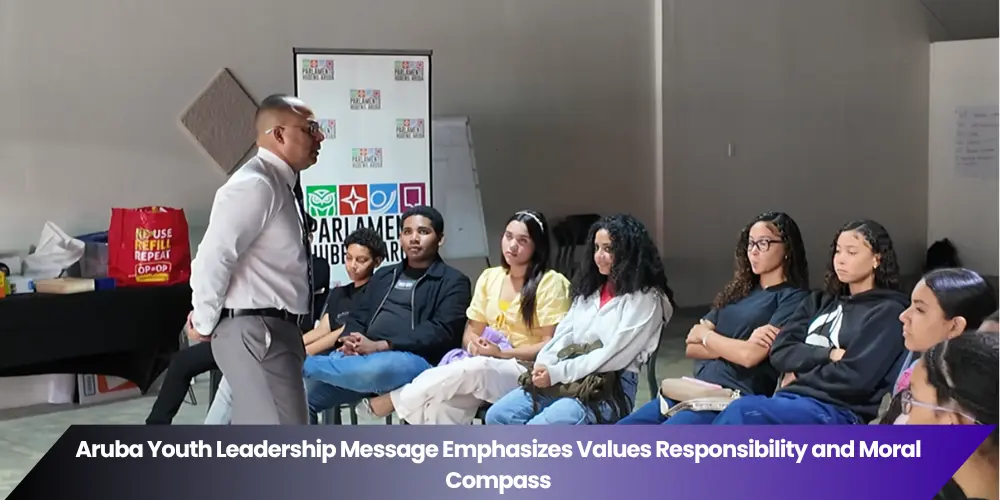
Aruba youth leadership was the focus of a recent Youth Parliament meeting where Parliamentarian Eduard Pieters shared his views on leadership, responsibility and the importance of strong personal values.
Pieters, leader of the Partido Patriotico Arubano parliamentary faction, said leadership is about much more than holding political office.
According to him, true leadership begins with the way a person communicates, works with others and remains committed to personal values during difficult moments.

The meeting brought together young participants and representatives of different parliamentary factions to discuss leadership and public service.
Pieters said one of the main objectives was to inspire the next generation of leaders by sharing principles that guide his own work.
He emphasized that young people represent Aruba’s future and that the decisions they make in the years ahead will influence how the country develops.
Leadership Means Responsibility
Pieters said leadership should not be defined only by authority.
Instead, he described responsibility as one of the most important qualities of a leader.
A strong leader, he said, must know how to communicate, build relationships and encourage positive change within the community.
“The leader is not simply the person who gives orders,” Pieters said.
He added that leaders must be able to listen, connect with people and inspire others to take action because they want to, not merely because they are required to.
Essential Qualities of a Leader
During his presentation, Pieters highlighted several skills and responsibilities that he considers important for effective leadership.
These included strong communication, the ability to build human relationships, willingness to challenge the status quo, adaptability and flexibility.
He also placed particular emphasis on integrity.
Pieters said leaders frequently work with people who have different backgrounds and personalities, making flexibility an important skill.
However, he stressed that adaptability should never require a person to abandon core principles.
Values as a Moral Compass
For Pieters, the foundation of leadership goes deeper than technique or experience.
He told participants that their norms, values, ideals and beliefs form their moral compass.
These principles, he said, are especially important when difficult decisions must be made.
Pieters argued that leadership should not be measured by popularity.
Instead, a leader’s character becomes visible through the decisions they are willing to make when facing pressure or uncertainty.
Preparing Young People for the Future
Pieters said the message was intended to apply not only to political leadership but also to the broader role young people can play in society.
He encouraged Youth Parliament participants to think about their future and how they can become agents of positive change.
The objective, he said, is for young people to leave these experiences with greater knowledge and stronger confidence in their own abilities.
Pieters said Aruba needs future leaders who are prepared, responsible and committed to the country.
He concluded that investing in Aruba youth leadership is one of the most important investments a country can make, because tomorrow’s leaders are shaped by the values they learn today.