
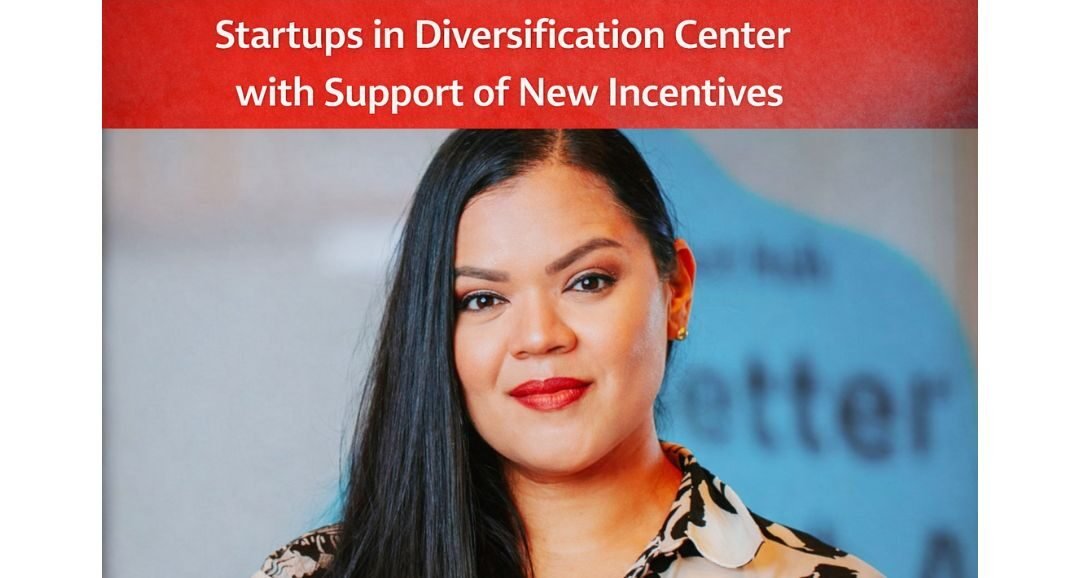
ORANJESTAD (AAN): Mary-Ann Falconi-Rasmijn, Co-founder and General Director of Impact Hub Aruba, highlights that, based on her daily experience with entrepreneurs and startups, the biggest challenge of starting a business in a small economy is not a lack of ideas but the limitations of capacity, time, and space for sustainable growth.
Since 2022, Impact Hub Aruba has focused its efforts on directly addressing this challenge by supporting startups in diversification center with support of new incentives, helping them strengthen their capacity, structure, and readiness for gradual and responsible growth within Aruba’s economic context.
Small business owners often face financial constraints, fragmented resources, and significant pressure to meet commercial, administrative, and fiscal obligations, often before they can fully understand the market and adapt their business models. As entrepreneurs, they are fully immersed in the daily operations of their companies, focusing on ensuring a steady income while assuming various roles and responsibilities.

In this context, preparation and gradual growth are not optional but essential conditions for startups to stabilize, maintain continuity, and evolve.
As an organization operating within the entrepreneurship ecosystem, Impact Hub Aruba focuses its efforts on strengthening business capabilities, guiding early-stage startups, and preparing them for sustainable growth. Since 2025, the organization has served over 251 entrepreneurs, with an active membership of 50 startups, utilizing resources such as training, co-working space, and business coaching.
After two successful incubation programs and support for startups abroad, it is clear that startups in Aruba have talent, determination, and many innovative ideas. However, without structural support and space to learn and grow, this potential is unlikely to develop to its full extent.
In this context, the Aruba government introduced a fiscal incentive package for 2026, including the “startersregeling” and other measures related to the Free Zone, marking an important step in improving conditions for small businesses to stabilize and grow, according to international fiscal standards.
The “startersregeling” provides startups with room to focus on what is truly essential in their early stages: building a team, validating demand, establishing operations, and learning through “trial, error,” and “pivoting.” This approach aligns with international literature, which shows that a solid foundation and space for learning increase resilience and the potential for sustainable growth.
In a small economy with a limited local market, the quality of initial preparation determines how quickly a startup can succeed. Incentives that reduce financial pressure in the early years play a key role, but they must be part of a broader development process.
Incentives are most effective when integrated into a solid ecosystem. Local and international experience consistently shows that fiscal incentives alone are not enough to build a sustainable startup ecosystem. Organizations like the OECD and the World Bank emphasize the importance of intermediary organizations that work closely with startups to translate ideas, ambitions, and business models into practice.
This is precisely the space where Impact Hub Aruba has been operating since 2022. Through daily commitment to entrepreneurs, incubation programs, community building, and partnerships, Impact Hub Aruba focuses on strengthening the foundations that startups need to effectively utilize available opportunities. This includes strategic clarity, operational preparation, access to networks, and readiness for the next stage of growth.
For startups, intellectual property is a key consideration, especially for creative and technological ventures. Impact Hub Aruba recognizes the important role intellectual property plays in protecting original work and creating sustainable long-term value. However, in practice, most startups initially focus on market validation, achieving operational stability, and developing a functional model. Intellectual property becomes increasingly relevant as the business grows and its market positioning solidifies. In cases where brand creation is integral from the start, intellectual property holds significant value and is essential for protecting the value that has been created.
For Aruba, as a small economy with limited infrastructure and the obligation to comply with international fiscal rules, intellectual property treatment in fiscal incentives must be handled carefully. The current focus is on real-service activities and operations to maintain credibility and avoid international consequences. The design of the “startersregeling” encourages compliance and stability, not to limit creativity but to ensure that preparation and gradual growth are essential in Aruba’s economic context.
The new fiscal incentives are creating momentum. However, to translate this into sustainable growth, it will depend on how the government, ecosystem partners, and entrepreneurs move forward together.
Impact Hub Aruba will continue fulfilling its role as a strategic partner: providing ongoing support to partners and within the ecosystem, strengthening capacity, and translating opportunities into real growth. The organization’s experience shows that when incentives and ecosystem support work in alignment, startups are better prepared—not only to begin but to maintain continuity and evolve. Herein lies the true potential of these incentives: not just as fiscal tools, but as vital parts of a broader, resilient, and sustainable ecosystem. This opens real space for new sectors to grow and for a diversified economy ready for the future.