


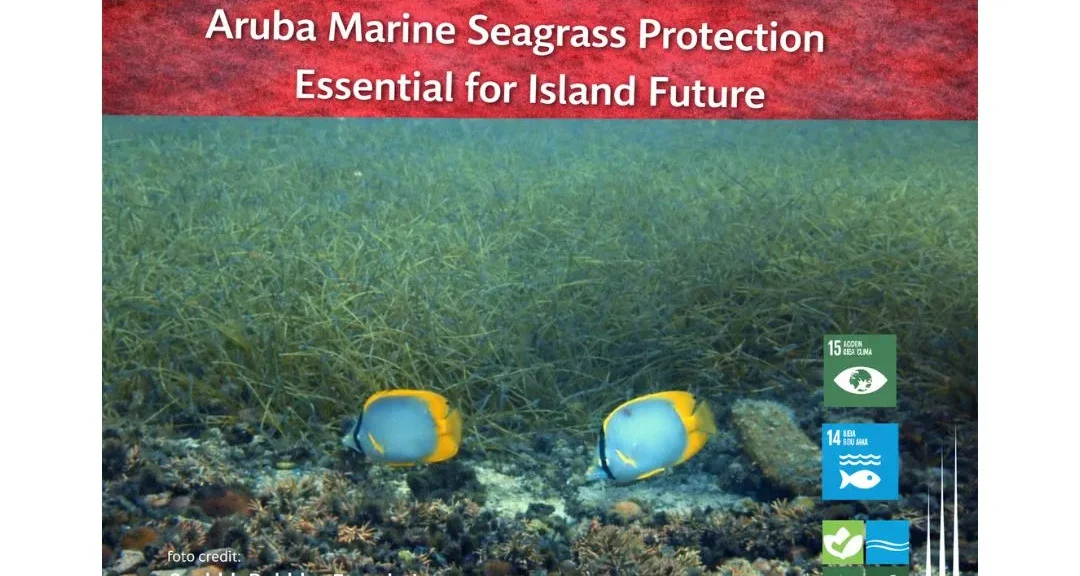
ORANJESTAD (AAN): The importance of Aruba Marine Seagrass Protection Essential for Island Future was highlighted on Sunday, March 1, as Aruba observed World Seagrass Day.
World Seagrass Day was officially proclaimed by the United Nations General Assembly in 2022 to raise awareness about one of the planet’s most productive and vital ecosystems. In Aruba, seagrass meadows play a critical role in maintaining coastal health, protecting beaches, supporting marine biodiversity, and strengthening the island’s economy.
The Directie Natuur en Milieu (DNM) continues to inform the public about the importance of internationally recognized environmental observances. According to DNM, Aruba Marine Seagrass Protection Essential for Island Future is not simply an environmental issue but also an economic and social priority.

Seagrass is often overlooked compared to coral reefs, yet it is one of the most valuable marine ecosystems in the world. Many people confuse seagrass with algae, but seagrass is unique. It is the only flowering plant that grows underwater, with roots, stems, and leaves. These underwater meadows act as the “lungs of the ocean,” forming vast ecosystems beneath the surface.
Several species of seagrass in Aruba are protected under local environmental laws. These underwater meadows provide nursery grounds for many fish species, seahorses, and sea turtles, including the White Sea Turtle. Without healthy seagrass habitats, marine biodiversity would decline significantly.
One of the most important functions of seagrass is its role as a natural filter. It traps sediments and pollutants, helping to keep Aruba’s waters clear and healthy. This clarity is essential for tourism, snorkeling, diving, and overall marine attractiveness.
The concept of “Blue Carbon” further strengthens the argument that Aruba Marine Seagrass Protection Essential for Island Future. Although seagrass covers only 0.1% of the ocean floor globally, it stores up to 18% of the ocean’s carbon. For Aruba, this makes seagrass a natural defense against climate change impacts.
Seagrass meadows also protect coastlines by reducing wave energy. They serve as a first line of defense against erosion and flooding during storms, helping preserve Aruba’s iconic white sand beaches.
However, seagrass habitats are under threat. Globally, approximately 7% of seagrass habitats are lost each year. In Aruba, major pressures include coastal development, pollution and runoff from land during heavy rainfall, boat anchoring, dredging activities, and climate change.
DNM emphasizes that protecting seagrass aligns directly with the United Nations Sustainable Development Goals (SDGs). By preserving seagrass, Aruba safeguards food security, water quality, and its blue economy.
The message remains clear: Aruba Marine Seagrass Protection Essential for Island Future is a shared responsibility. The community and future generations are encouraged to view seagrass not as a nuisance on the beach, but as a vital shield protecting Aruba’s coast and marine life.
















Discussion about this post