

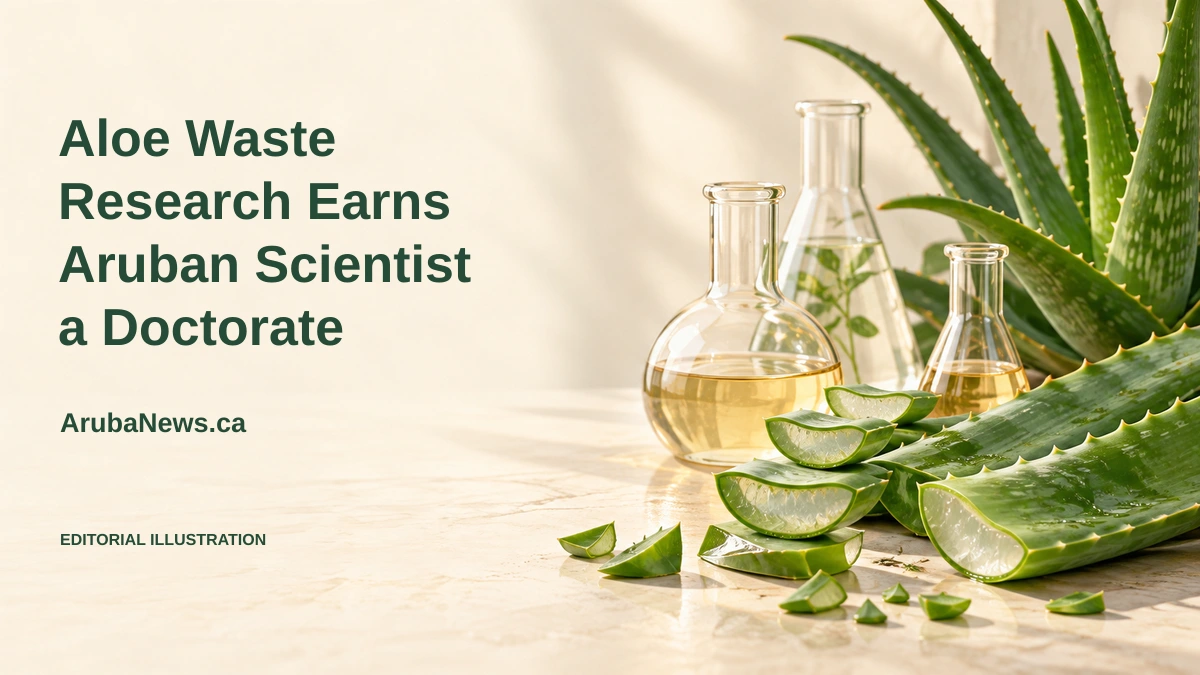
Aruban scientist Jeltzlin Zaïnah Semerel has earned a doctorate for aloe waste research examining how material left after processing the plant could become a source of useful chemicals, according to a November 1 report by 24ora.
The outlet reports that Semerel defended her thesis, Valorization of Aloe vera Processing Waste, on Tuesday at the University of Aruba. Her work formed part of the university’s SISSTEM programme in collaboration with KU Leuven in Belgium.
Finding value in aloe-processing remnants
The research considers the green outer leaf material and bitter yellow liquid left behind when aloe is processed for its gel. Semerel studied ways to extract and purify compounds from these remnants, including microwave-assisted extraction using specialised solvents, 24ora reports.

The work connects the reuse of agricultural waste with chemical research. For islands such as Aruba and Curaçao, the possibility of obtaining useful materials from an existing waste stream is relevant to circular-economy development. Commercial-scale technical and economic feasibility still needs to be established, according to the report.
Laboratory findings are not a cancer treatment
24ora describes a paper published in Molecules in May in which Semerel and colleagues developed six compounds based on aloe-emodin. One compound, identified as 10c, showed activity against lung- and breast-cancer cell lines grown in a laboratory.
These are early research findings, not evidence of an effective treatment for patients. Further work would be needed to assess safety and whether the activity persists in a living organism. The report also cautions that the publication does not establish that the aloe-emodin used to make those compounds came from Aruban or Curaçaoan processing waste.
Research links Aruba and Belgium
Semerel’s doctoral supervisors were Wim Dehaen and Pedro Fardim, with the University of Aruba’s Nigel John as co-supervisor, according to 24ora.
Source: Read the original 24ora report.