

ORANJESTAD, Aruba – Aruba Financial Oversight is entering a new phase as the Government of Aruba moves forward with independent audits of its 2026 and 2027 annual accounts after eliminating a long-standing backlog in government financial reporting.
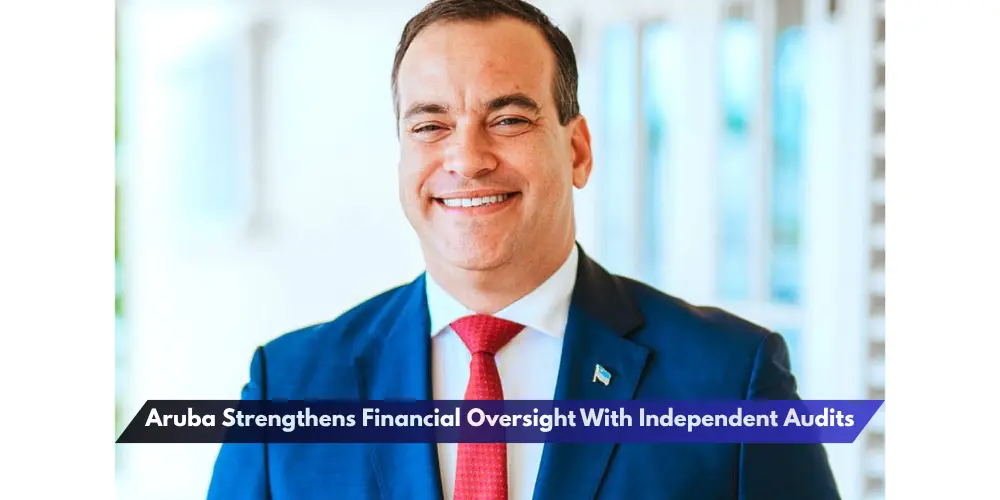
According to Minister of Finance, Economic Affairs and Primary Sector Geoffrey Wever, Aruba has now brought its annual accounts up to date after years of delays. The recent submission of the 2025 annual accounts marked an important milestone in restoring order, discipline and transparency to the country’s financial management.
As a next step, the government has signed an agreement with SOAB, a financial auditing company, to conduct professional audits of the government’s annual accounts for 2026 and 2027.

Wever said the agreement is intended to consolidate the progress already made and prevent Aruba from returning to the delays that characterized public financial administration for many years.
He emphasized that the objective is not simply to clear the backlog, but to create a financial system that operates structurally and consistently with proper controls, transparency and accountability.
According to the minister, Aruba must be able to submit its annual accounts on time and ensure that those accounts can be reviewed through a professional audit process.
The Aruba Financial Oversight initiative has two major objectives.
First, the agreement with SOAB will allow the 2026 and 2027 annual accounts to be audited by professional accountants. This creates the necessary foundation for the government’s financial statements to be formally reviewed and potentially certified.
Second, the government intends to use the 2026–2027 period to strengthen the capacity of CAD, the institution normally responsible for auditing the Government of Aruba’s annual accounts.
The plan is for CAD to use this period to further develop its internal organization, knowledge, skills and professional capacity. Once that process is completed, CAD is expected to resume responsibility for future government audits.
In this way, the government says it is not only seeking a short-term solution but also investing in a sustainable system for the years ahead.
Funding for the audit and capacity-building process will come from the Landspakket under Theme A – Financial Management, which is being implemented in cooperation with the Netherlands.
The program is focused on strengthening Aruba’s financial administration and internal control systems on a structural basis.
Minister Wever said the combination of bringing annual accounts up to date, introducing professional independent audits and strengthening CAD represents the next stage in the modernization of public financial management.
He stressed that financial credibility is not achieved through a single decision. Instead, it must be built gradually through discipline, strong institutions and procedures that function consistently over time.
The government’s aim is to ensure that timely financial reporting becomes the standard rather than an exception.
Aruba Financial Oversight is therefore being positioned as part of a broader effort to improve transparency, accountability and confidence in the management of public finances.
The agreement with SOAB also provides a transition period during which Aruba can maintain professional audit coverage while building the capacity of its own institutions.
Wever said the progress made so far demonstrates that Aruba can correct long-standing administrative problems when there is a clear structure and continued commitment.
He concluded that after eliminating years of delays, the next priority is to ensure that Aruba remains up to date and that reliable financial reporting becomes a permanent feature of government administration.