
The Mirto Lacle Macondo Cycle interview highlights the literary legacy of Nobel Prize–winning author Gabriel Garcia Marquez as the world commemorates the 99th anniversary of his birth.
Across Colombia and internationally, readers and literary communities are remembering the influential writer, whose works have been translated into numerous languages and continue to attract readers across Latin America, Europe, North America, and the Caribbean.
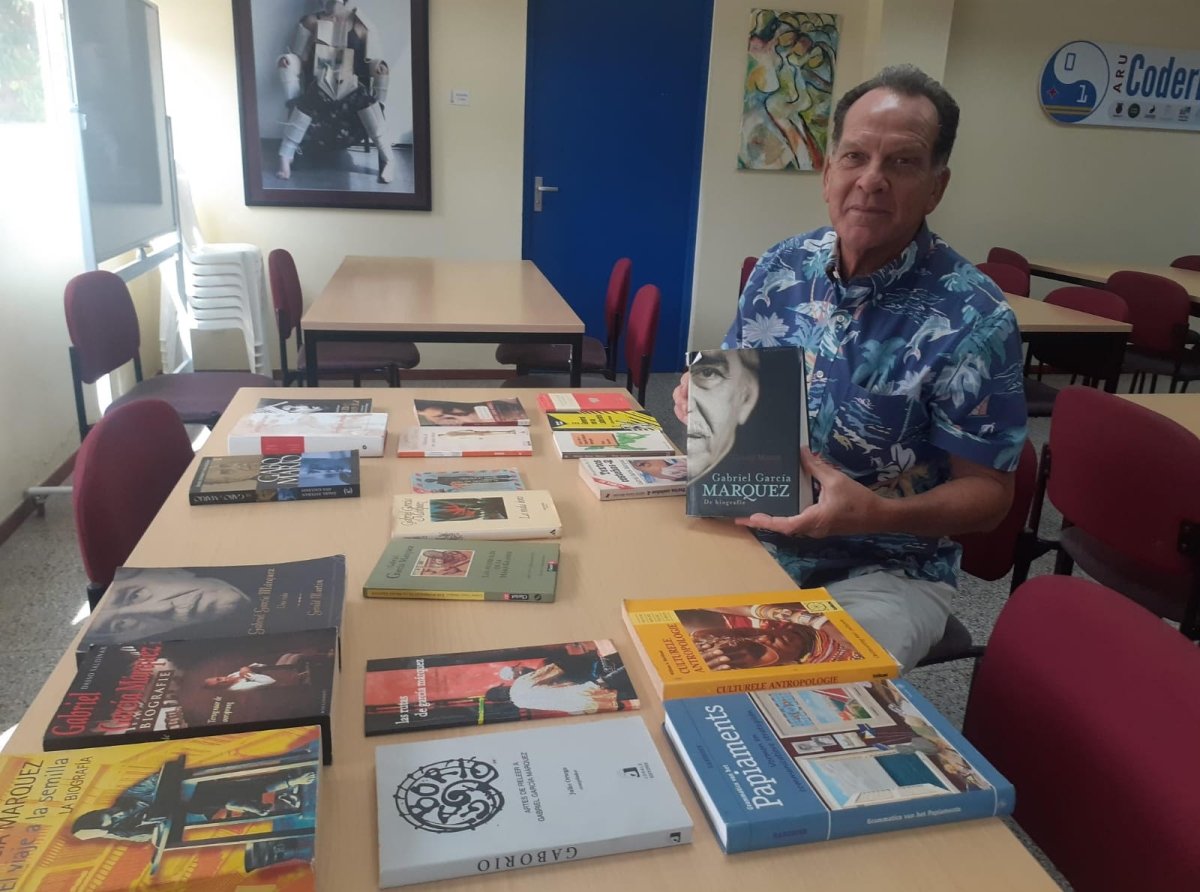
During the Mirto Lacle Macondo Cycle interview, linguist and cultural manager Mirto Lacle shared insights about the author widely known as “Gabo.” Lacle, a dedicated reader of Garcia Marquez’s works, has collected many of the author’s literary publications and has studied his influence in depth.

Focus on “One Hundred Years of Solitude”
In the Mirto Lacle Macondo Cycle interview, Lacle spoke extensively about the novel “One Hundred Years of Solitude” (Cien Años de Soledad), first published in 1967. The book remains one of the most influential works of Latin American literature.
Lacle explained that during his studies, he researched Garcia Marquez’s writing and even presented academic work about the author at the University of Amsterdam. His interest in Garcia Marquez began while he was studying at Colegio Arubano, where he started noticing connections between the themes in the author’s work and broader cultural narratives.
According to Lacle, the novel was originally intended to be titled “La Casa” (The House). The idea was inspired by the house where Garcia Marquez grew up with relatives, where storytelling and family memories played a central role in shaping his imagination. Eventually, the title was changed to “One Hundred Years of Solitude.”
The Mythical Town of Macondo
The Mirto Lacle Macondo Cycle interview also explored the concept of Macondo, the fictional town that serves as the setting of the novel. The town is believed to be inspired by Aracataca, the Colombian town where Garcia Marquez was born.
Lacle explained that the story spans seven generations, divided into numerous narrative episodes that depict the rise and decline of the Buendía family and the town itself.
One of the central figures guiding the early development of Macondo is José Arcadio Buendía, a character who symbolizes the founding spirit of the community. Over time, however, outside influences and social changes reshape the town.
Historical and Social Themes
During the Mirto Lacle Macondo Cycle interview, Lacle also pointed to historical themes within the novel, including references to the influence of multinational corporations such as the United Fruit Company, which played a controversial role in parts of Latin America.
According to Lacle, these events illustrate how powerful external forces can enter a community, exploit its resources, and later abandon it. He compared these themes with broader migration and social transformation processes that many societies experience, including Aruba.
Lacle described this narrative structure as the “Macondo Cycle,” explaining that the concept represents a cycle of growth, transformation, and eventual decline.
“A cycle eventually closes,” Lacle said, reflecting on the broader symbolism of the story.
Looking Ahead to the Author’s Centennial
The Mirto Lacle Macondo Cycle interview is only the first part of a broader discussion that will continue in the coming days. Lacle also noted that no special event is being held this year to mark the author’s birthday because organizers are planning to celebrate the centennial of Gabriel Garcia Marquez’s birth next year.
The upcoming centenary celebration is expected to provide an opportunity to honor the author’s literary legacy and the global impact of his work.