


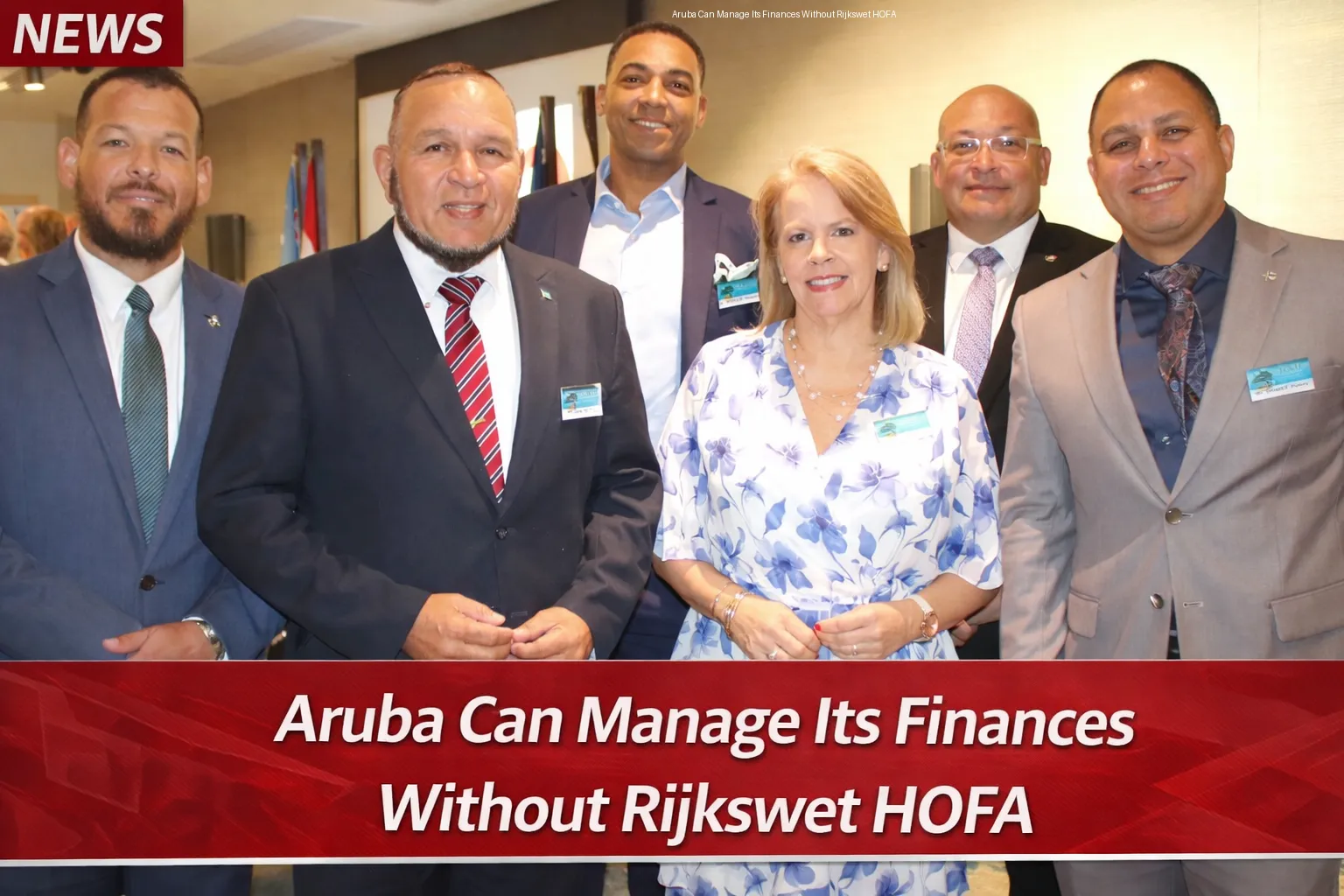
Aruba Manages Finances Without HOFA, according to MEP Parliamentary Leader Evelyn Wever‑Croes, speaking at the Interparliamentary Kingdom Consultation (IPKO) held in Aruba.
During the meeting with Dutch parliamentarians, the MEP faction delivered a strong message: “NOS MES POR” (We Can Do It Ourselves). Wever‑Croes began by presenting Aruba’s current financial situation, noting that the country is in good financial health.
“This year we have a 2.6% GDP surplus, and within two years we expect to reach our debt‑to‑GDP target of 47% — below the goal of 50%. Those familiar with Aruba’s financial history know this is a major achievement. In 2015, the government at that time doubled the debt, but today we are well below our target. This was accomplished by Aruba itself,” she said.

Wever‑Croes emphasized that Aruba has achieved these results under its own governance framework and existing financial supervision system without the need for the Kingdom law (Rijkswet) HOFA.
“I believe the Kingdom law is not necessary. The very concept of the Rijkswet HOFA currently on the table is, in my view, contrary to our Constitution, contrary to the IPPKO agreements of 2022 and 2025, and contrary to the Aruba‑Netherlands agreement of 2024. Additionally, this proposed law does not have majority support in Parliament or in the community,” Wever‑Croes stated.
She also criticized the high interest rates Aruba has paid. Aruba has already spent two years paying high interest — 6.9% — to the Netherlands. Wever‑Croes pointed out that Curaçao and Sint Maarten pay around 3.4% interest, meaning the Netherlands gains an additional 3.5% simply by insisting on the HOFA law.
“We are paying 6.9% interest to the Netherlands, and we’ve completed two years of those payments. This is not because Aruba is financially risky or incapable of managing its finances — Aruba is meeting all fiscal standards. Yet the Netherlands continues to insist that we must adopt the Kingdom law. If the Netherlands truly wants to help Aruba, it should lower the interest rate without demanding we change our financial supervision system to a Kingdom law that is harmful for Aruba,” she argued.
At the end of her presentation, Wever‑Croes asked the director of finance, who was present, why the Netherlands continues to push for the Kingdom law despite Aruba having its finances in order. There was no answer to her question.
“We are convinced that Aruba — and this government — will continue on the financial course we have set. We believe in a modern financial supervision system, but not in a Kingdom law,” said Evelyn Wever‑Croes, reiterating her stance on Aruba’s financial autonomy.